How to Build a Customer Acquisition System That Attracts and Captures Buyers Daily
This is Part 1 of a 3-part series breaking down the complete $100K growth system. Part 2 covers Convert. Part 3 covers Engage and Refer.
Most businesses are working far too hard for far too little. Posting across six platforms. Sending cold DMs. Running 10 different email domains with 20 inboxes each. All for a handful of mediocre leads that never convert.
There is a better way. One that brings qualified buyers to you every single day, pays for itself as it runs, and takes about four hours a week to maintain once it is built.
This is the customer acquisition system we use across SaaS businesses, service providers, coaches, consultants, agencies, and even publicly listed companies launching new products. It works because it is built on a model, not a collection of disconnected tactics.
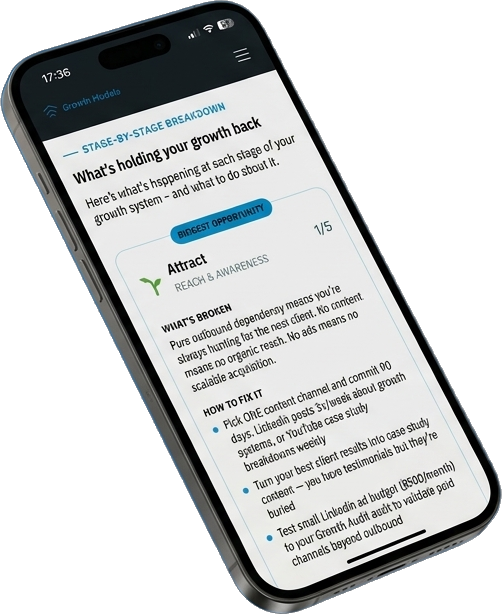
Get a free five-step strategy to grow your business more profitably
Answer a few questions about how you get and keep customers, and get a detailed report on the handful of actions that'll grow your business more profitably. Free, about five minutes.
In this article, we are breaking down the first two stages of that model: Attract and Capture. These are the stages that determine whether your business has a predictable pipeline of buyers or a leaky bucket of strangers who never return.
The Three Rules That Every Customer Acquisition System Must Follow
Before we build anything, you need to understand the economics. Jay Abraham distilled business growth into three rules of revenue growth:
- Attract more buyers. More opportunities means more revenue. Simple maths.
- Increase the transaction value. Get each buyer to pay you more per purchase.
- Increase repeat purchases. Get them to buy again. This is where the real profit lives.
Here is the critical insight most people miss. The best offer does not always win. The company that can afford to spend more to acquire a customer usually wins.
Think about it. Brand A can afford to spend $100 to get a customer. Brand B can spend $200. For every ad Brand A runs, Brand B runs two. For every opportunity Brand A gets, Brand B gets double. The economics of customer acquisition dictate everything.
This is why we build our system around breaking even on the front end. You spend $100 on ads today. You make $100 back tomorrow. You have acquired a customer for free. And you can keep scaling because there is no ceiling on what you can spend.
That is the foundation of the ACCER framework: Attract, Capture, Convert, Engage, Refer. Five stages. One system. Each stage feeds into the next.
How to Attract Buyers Without Building a Hamster Wheel
The attract stage answers one question: how do you get your brand and your offer in front of the right people every single day?
If someone asked you right now, “How are you reaching your ideal customers?” and you cannot give a clear, specific answer, your business is going to struggle. You need a dialled-in mechanism for getting in front of qualified buyers consistently.
Most people try to solve this with organic content. Years of grinding out social posts, YouTube videos, blog articles. Here is the problem with all of those approaches:
- Organic social: Algorithms are unpredictable. One post goes semi-viral, the next identical post gets 30 views.
- SEO: AI summaries are destroying click-through rates. People get answers from ChatGPT before they ever reach your content.
- Cold outreach: You need increasingly complex systems. Thousands of emails for a handful of opportunities.
None of these give you control. None of them give you predictable, compounding reach.
Why Paid Ads Are the Foundation of a Real Attract System
With ads, you are guaranteed reach. You pay, you get shown to people. You always get priority placement over organic content. And when you find something that works, you can scale it by simply spending more.
That is not to say organic content is worthless. It is not. But it should not be your primary acquisition engine. Ads alone will not save a broken business either. What saves a business is a complete system where ads feed into a model that pays for itself.
The old method of running ads to a webinar, booking a sales call, and closing in three days does not work anymore. What used to cost $200 per call now costs $700 to $800. That breaks the economics entirely.
Instead, we use ads to drive traffic to a low-ticket front-end offer that self-liquidates. You spend $100. You make $100 back within 24 hours. The customers who buy go into an automated system that pre-sells your high-ticket offer. We cover that conversion mechanism in Part 2.
Setting Up Your Customer Acquisition System in Meta Ads
Here is the practical setup for your attract stage. This is what we are running right now, and it works across industries, price points, and business models.
Step 1: Get Your Tracking Right
Before spending a penny on ads, set up both server-side tracking and pixel-based tracking. Your checkout tool (ThriveCart, ClickFunnels, GoHighLevel, whatever you use) will have a guide for this. Follow it.
If you are early stage, just use the Facebook pixel plus server-side tracking from your checkout tool. Once you are generating $5K or more per month in ad revenue, consider adding a tool like Hyros for more granular tracking.
The three key conversion events to track:
- Leads generated
- Add to cart
- Purchases
Step 2: Build Your Audiences
This is where attract and capture start working together. You need three audience types:
Cold audience: People who have never heard of you. Strangers. This is your reach engine.
Warm audience (engagers): People who have visited your website, engaged with your Instagram posts or ads, or interacted with your Facebook page in the last 180 days. This is your capture mechanic.
Lookalike audience: A 4 to 10% lookalike built from your purchasers. Facebook finds more people who look like the ones already buying from you.
Set these up before you launch a single ad. It takes 20 minutes.
Step 3: Launch Two Campaigns
The entire ad structure is two campaigns:
Campaign 1: Cold traffic. This goes out to everyone. Its job is twofold. First, hoover up the 1 to 3% of your market who are impulse buyers, ready to purchase right now. Second, fill your warm audience with people who engaged but did not buy yet.
Campaign 2: Warm retargeting. This serves the same ads to people who have already shown interest. This is forced familiarity in action. They keep seeing you. They start to prefer you. Eventually, they buy.
Here is the counterintuitive part. You run the exact same ads in both campaigns. Same copy. Same creative. Same offer. The only difference is the targeting. Duplicate the campaign, change the audience, done. The whole setup takes 10 to 15 minutes.
The New Capture Mechanic: Why Pixels Beat Lead Magnets
Here is where the model has shifted. For years, the capture stage meant lead magnets. Give away a PDF, get an email address, nurture them towards a purchase.
That still works. But we are seeing better results with a different approach.
Instead of asking for an email address upfront (which attracts freebie-seekers), we use audience-based capture. Anyone who engages with your ads, visits your website, or interacts with your social content gets captured into your warm audience automatically. No opt-in form needed.
That engagement is a digital hand raise. They have said, “I am interested in this.” Now you can serve them more ads until they buy.
This approach filters for serious buyers from the start. People who spend even a single dollar with you are between 12 and 56 times more likely to buy again than people who came through a free lead magnet. That is not a marginal difference. That is a fundamentally different quality of customer.
The capture mechanic feeds directly into the convert stage. Cold traffic builds your warm audience. Warm retargeting drives purchases. Purchases feed your email list for the engage stage. Each piece of the system feeds the next.
Creative Is the Only Variable That Matters
When testing ads, most people obsess over copy, headlines, and targeting. All of those matter. But right now, the single biggest difference-maker is the creative: the image or the video.
We test five ad creatives at a time. Same copy across all five. Different images or videos. Run them for one to two weeks. Take the winners, scale them up. Kill the losers. Start the cycle again.
The format that is working well right now for image ads is simple: a square image leading with the transformation, an image of the product, some bullet points about what it does, then a call to action. Nothing fancy. Direct and clear.
For video ads, test different angles, different styles, different hooks in the first three seconds. The creative is what stops the scroll. Everything else is what closes the deal.
How Much Should You Spend on Ads?
As much as you can afford. Ideally, start at $50 per day. If that is too much, $10 per day works. Just understand that what takes 10 days to learn at $10 per day, you learn in one day at $100 per day.
Think of ad spend not as buying customers, but as buying data. You are buying information about what your audience wants, what resonates with them, and what makes them take action. More spend means faster learning.
Do not take out a loan to run ads. That is reckless. Invest what you can afford and accept that lower budgets mean a longer timeline to find what works. Even $10 per day beats $0 per day because you are getting feedback that organic methods simply cannot match.
The Spearfishing Alternative for Zero-Budget Starts
What if you have no ad budget at all? You can still get your first 10 customers through what we call spearfishing. Create value posts in existing communities where your ideal customers already hang out. Engage with the people who respond. Build relationships one at a time.
It is not scalable. It is not efficient. But it gets those first customers through the door so you can build proof, generate revenue, and eventually fund your ad spend. Once you have ad spend, switch to the system above and never look back.
Putting Attract and Capture Together
Here is how these two stages work as a unified customer acquisition system:
- Ads go out to cold traffic. Strangers see your offer for the first time.
- Impulse buyers purchase immediately. They enter your convert stage and then your engage system.
- Everyone else gets captured into your warm audience through pixel tracking and engagement data.
- Warm retargeting serves the same ads to build forced familiarity until they are ready to buy.
- Purchases feed your email list where the engage stage pre-sells your high-ticket offer.
No lead magnets. No freebie-seekers. No guessing. Just a predictable engine that attracts buyers, captures interest, and feeds the rest of your growth system automatically.
The attract stage brings them in. The capture stage makes sure they do not disappear. And the Rule of One keeps you focused: one primary channel, one system, compounding results.
Frequently Asked Questions
Do I need a big budget to build a customer acquisition system?
No. You can start with as little as $10 per day in ad spend. Lower budgets just mean slower learning cycles. The system works the same way at $10 per day as it does at $100 per day. You can also start with zero budget using community-based outreach, then reinvest revenue into ads once you have proof and cash flow.
Should I still use lead magnets to capture leads?
You can, but audience-based capture through pixel tracking is outperforming traditional lead magnets for most businesses right now. The reason is simple: people who come through free lead magnets have shown they want free things. People who engage with paid content and eventually buy have shown they are willing to spend money. The quality of buyer is fundamentally different.
How long before I see results from this attract and capture system?
You should see your first purchases within the first week of running ads, even on a low budget. The system becomes predictable once you have enough data to identify winning creatives (usually two to four weeks). From there, it is a matter of scaling what works and cutting what does not.
What if Meta ads stop working or get too expensive?
The principles behind this system (paid reach, audience-based capture, forced familiarity, self-liquidating economics) apply to any paid channel. If Meta becomes unviable, the same structure works on Google, YouTube, TikTok, or whatever platform your audience uses. The model stays the same. Only the channel changes.
Can this work for service businesses, not just product businesses?
Yes. We have used this exact model with freelancers, agencies, consultants, SaaS companies, e-commerce brands, and publicly listed companies. The attract and capture mechanics are universal. The difference is in what you sell on the front end and how you structure the engage stage on the back end.
Not sure where your growth system is leaking? Take the free growth diagnostic. It maps your business against all five ACCER stages and shows you exactly where to focus first.
Next up: Part 2 covers the Convert stage, where we turn this traffic into paying customers using a self-liquidating offer funnel that pays for your ads within 24 hours.