How to Build a Customer Retention System and Referral Engine That Prints Profit
This is Part 3 of a 3-part series breaking down the complete $100K growth system. Part 1 covers Attract and Capture. Part 2 covers Convert.
Most businesses spend all their energy chasing new customers. More ads. More content. More outreach. Then they wonder why profit stays flat despite growing revenue.
The problem is not acquisition. It is what happens after the first sale.
Your customer retention system and referral marketing system are where the real profit lives. The front end of your business funds customer acquisition. The back end is where you actually make money after the first sale.
Get a free five-step strategy to grow your business more profitably
Answer a few questions about how you get and keep customers, and get a detailed report on the handful of actions that'll grow your business more profitably. Free, about five minutes.
In the ACCER framework, these are the final two stages: Engage and Refer. Get them right and every customer you acquire becomes more valuable. Get them wrong and you are stuck on a treadmill, paying full price for every sale forever.
The Engage Stage: Your Customer Retention System
The Engage stage has one job. Get people who paid you once to pay you again.
A customer pays you once. A client pays you repeatedly. The goal of your customer retention system is to turn the first group into the second.
This is where most of your profit is made. Buyers from your front-end funnel are 12 to 56 times more likely to purchase again than people who came through a free lead magnet. That stat alone should tell you where to focus.
Google’s 7-11-4 Rule for Post-Sale Customer Engagement
Google ran a study analysing what it takes for somebody to spend larger amounts of money with a business. They found that a prospect needs to consume 7 hours of content, across 11 different touchpoints, through 4 different channels before they feel comfortable making a significant purchase.
That is not a hard rule. Nobody hits exactly seven hours and suddenly feels compelled to buy. The principle is simple: the more exposure someone has to your brand, the more trust they build, and the more comfortable they feel spending money with you.
Most businesses hear this and think they need to create a mountain of content. They do not. They need a system that directs existing customers through content strategically. And that system is built on two mechanisms.
Mechanism 1: Forced Familiarity
Forced familiarity is a psychological phenomenon. Repeated exposure to something, even when you are not actively looking for it, leads to preference for that thing.
If you keep seeing ads for Product A every single day, you start to prefer Product A over Product B. Not because you have evaluated both. Just because Product A feels more familiar. It is subconscious.
This is why the company that can afford to spend more on customer acquisition usually wins. More spend means more visibility. More visibility means more familiarity. More familiarity means more preference.
But you do not need a massive ad budget to manufacture forced familiarity. You need email.
Most businesses email their list once a week. Maybe once a fortnight. That is not enough to build familiarity. The brand showing up every single day is the one people remember. The one emailing every Tuesday gets lost.
Here is the system. You send a daily email. Each email links to a piece of content on a different channel. One day it is a YouTube video. The next it is a blog post. Then a community thread. Then a social post. Every piece of content links back to your primary sales mechanism, whether that is a sales page, a booking link, or a webinar.
Email is channel one. YouTube is channel two. Social is channel three. Blog is channel four. Community is channel five. That is five channels covered. Daily emails across those channels rapidly build up the 7-11-4 requirement without you having to create anything new each day. You can even revive a dead email list with this approach and generate sales within weeks.
Mechanism 2: Sequential Objection Removal
Here is where most post-sale customer engagement falls apart. Businesses show up daily but every message says the same thing: “Buy now.”
Imagine someone knocking on your door every day asking if you want to buy their thing. You say no. They come back tomorrow and ask again. Same pitch. Same words. You are never going to say yes on day 17 just because they asked 17 times.
There is a reason the person is not buying. Maybe they do not believe it will work. Maybe they think the price is too high. Maybe they are not sure they can do it. You do not know which objection is holding them back.
Different people view your offer through different lenses:
- Price lens: Can I afford this? Is it worth it?
- Proof lens: Does this actually work? Show me evidence.
- System lens: How does it work step by step?
- Safety lens: What if it does not work? Is there a guarantee?
- Ease lens: Can I actually do this? Is it too complicated for me?
Your customer retention system needs to sequentially remove these objections through content. Not by saying “buy now” every day, but by addressing a different concern each day.
How to Structure Your Engage Sequence
Here is the practical structure. After someone buys your front-end product, they enter a daily email sequence. Group emails into blocks of three, each block targeting a different objection lens.
Emails 1-3: Address price objections. Content shows how a modest investment produces outsized returns. Links to a YouTube video with a case study. The final email in the block links directly to your sales mechanism.
Emails 4-6: Address system objections. Walk through how the process works step by step. Content demonstrates the methodology so prospects can believe it is a real, tested system.
Emails 7-9: Address proof, safety, or ease objections. Testimonials, risk reversal, simplicity demonstrations.
Each block uses a different piece of deep content, a video, a case study, a walkthrough, to build trust through a different channel. The emails drive traffic to that content. The content links back to the sales mechanism.
By the end of the sequence, you have shown up every day (forced familiarity), addressed every major objection (sequential removal), and directed them through multiple channels and touchpoints (7-11-4 fulfilment). The person hitting your sales page at that point already knows the price, believes it works, understands the system, and feels safe. All that is left is the final confirmation.
This approach follows the Rule of One. One system, one email sequence, one high-ticket offer. No complexity. No juggling seven different funnels.
Real Results from an Engage Sequence
One client had a completely cold email list. Had not emailed in two years. About 4,500 to 5,000 people. Selling a product at roughly $500.
We built one of these engage sequences, spent a week rewarming the list, then ran the emails. Within two weeks it generated $13,100. With an additional sale and bump offer, it pushed just under $14,000. From a list that had been sitting there doing nothing.
That is the power of forced familiarity plus objection removal applied to people who already know you. Even cold audiences respond when the system is built properly.
The Refer Stage: Your Referral Marketing System
The whole purpose of the Refer stage is to turn one customer into two. If you are paying $20 to acquire a customer and that customer refers a friend, your effective cost per acquisition drops to $10. Do that consistently and your growth compounds without proportional increases in ad spend.
There are two referral marketing system approaches that work for most businesses: affiliate partnerships and review manipulation.
Affiliate Referral Systems: Pay on Success
Affiliates are the purest form of referral marketing. You only pay when they deliver a result.
The setup is simple. Find someone with an audience that overlaps yours. Reach out. Offer them at least 50% of your front-end funnel value for every customer they send you.
You might flinch at 50%. Do not. If you are paying for ads, you might only clear $5 to $10 profit per customer on your front-end funnel. With an affiliate, you will often make more than that even after paying them their cut. And the volume from a good affiliate can be massive.
For super affiliates with large, established audiences, offer up to 95%. Keep 5% to cover processing fees. The front-end funnel is not where you make your profit anyway. It is the engine that feeds buyers into your Engage stage, which is where the real money is made.
Two things make affiliate partnerships work:
- Make promotion effortless. Write all the emails for them. Provide images, copy, and links. They should be able to copy, paste, and send to their audience that same day. If they have to figure out how to promote your product, they will not do it.
- Pay after the refund window. If you have a 14-day refund policy, pay affiliates on day 15. This protects you from people gaming the system with junk traffic that refunds immediately.
Where to Find Affiliates
Your best affiliates are already in your customer base. The first place to look is your existing buyers.
Set up an automated email that goes out three weeks after purchase, once they have had time to get results. Something simple: “If you have an audience and would be willing to share this with them, hit reply. We will set you up as an affiliate.”
Even in B2C, this works. Think of Dropbox. Every user could increase their free storage by referring a friend. If each person refers just one person, you double your customer base.
Beyond existing buyers, look at:
- Industry groups: Facebook groups, School communities, Circle communities, forums
- Newsletters: Substack search, Kit’s discover tab, niche email lists
- Google search: Websites and audiences in your niche that are not direct competitors
- Meta Ad Library: Search for people running ads for non-competing but related products. They are already investing in growth and may want a partnership
Review Systems: Gaming Discoverability
The second referral system is review manipulation. And yes, that is exactly what it is. Strategic, incentivised accumulation of positive reviews on platforms where your buyers already search.
One software company scaled to six-figure months largely through this. They identified the top review platform in their industry, the equivalent of G2 or Trustpilot, and made becoming the number one rated product their singular focus.
The process:
- Wait for a win. When a customer shares a positive result in your community, feedback form, or support channel, jump on it immediately.
- Request private feedback first. Send NPS surveys or simple satisfaction checks. Anyone scoring 7+ out of 10 gets a follow-up asking them to share that feedback publicly.
- Direct them to one specific platform. Not “leave a review somewhere.” Pick the platform that drives the most referral traffic in your industry and send them directly there.
- Incentivise it. A discount on their next purchase. A trial extension. A small gift card. Without an incentive, some people will leave reviews out of goodwill. With one, both the volume and quality of reviews increase significantly.
The software company mentioned above used trial extensions as the incentive. A 7-day trial could be extended by another 7 days for a referral, another 7 for a positive review on the industry review platform, and another 7 for mentioning the brand in a relevant Facebook group. Three actions, each driving referral traffic through a different channel.
When people search “best X for Y” on Google, through AI tools, or directly on review sites, you want to be in the top three. That position drives passive referral traffic indefinitely.
The Complete System: Engage and Refer Together
Here is how both stages fit together in the full ACCER model.
The front end (Attract, Capture, Convert) brings in buyers and ideally breaks even on ad spend. That is the acquisition engine.
The back end (Engage, Refer) is the profit engine. Engage turns one-time buyers into repeat customers through forced familiarity and objection removal. Refer turns happy customers into affiliates and review advocates, feeding more people back into the top of the funnel.
Together they create a growth flywheel. Each new customer has the potential to generate repeat revenue and bring in additional customers at zero acquisition cost.
The build order matters. Start with your high-ticket offer and your ICP. Then build the Engage sequence: three to five pieces of deep content and one to three emails per piece. Then build the Convert stage front-end funnel. Then Attract and Capture with ads. Finally, layer on Refer with affiliate outreach and review systems.
Once built, the only parts requiring regular attention are your ads and your Engage content. Everything else runs on autopilot. Four hours a week of maintenance. That is the whole system.
Frequently Asked Questions
How often should I email my customer list for post-sale engagement?
Daily. The data is clear on this. Brands that email weekly or fortnightly get lost. Daily emails build forced familiarity, the psychological mechanism where repeated exposure creates subconscious preference. Each email should link to content on a different channel and address a different objection. Not every email is a sales pitch. Most are trust-building content that happens to link back to your offer.
What is the difference between an engage sequence and a standard nurture sequence?
A standard nurture sequence sends generic value content and occasionally drops in a sales email. An engage sequence is strategic. Every email is built around one of five objection lenses (price, proof, system, safety, ease) and links to deep content designed to remove that specific objection. It combines forced familiarity with sequential objection removal to systematically move people toward your high-ticket offer.
How much commission should I offer affiliates?
At least 50% of your front-end funnel value. For high-volume super affiliates, go up to 95%. Keep 5% minimum to cover processing fees. Your front-end funnel exists to acquire buyers, not to generate profit. The profit comes from the Engage stage when those buyers ascend to your high-ticket offer. Paying affiliates generously brings in more buyers at zero ad cost.
What if I sell B2C products? Do affiliate and referral systems still work?
Yes. Dropbox scaled almost entirely through a customer referral system where users earned extra storage for inviting friends. Even if your customers do not have formal audiences, they have friends, they participate in communities, and they belong to groups related to your product. An automated post-purchase email asking “know someone who would benefit from this?” with a referral incentive is enough to get started.
Should I build the Engage stage or the Convert stage first?
Engage first. Always. You need a way to sell your high-ticket offer before you start driving traffic to it. Build the Engage sequence, test it on whatever audience you have now (even a small email list), validate that it converts, then build the front-end funnel to feed it with more buyers. Building acquisition before you have a working profit engine is how businesses burn through cash.
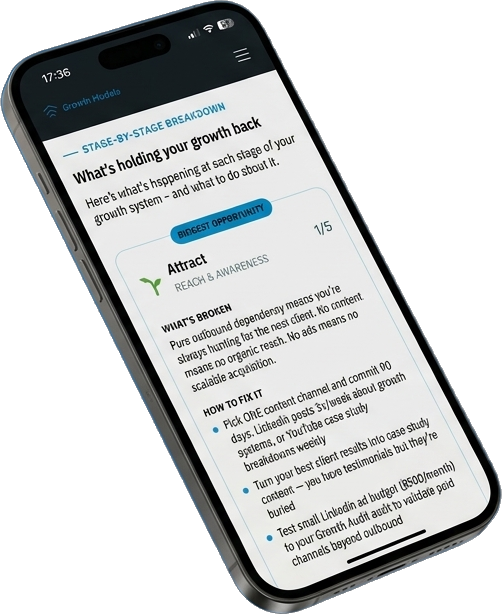
Not sure which stage of your growth system needs the most work? Take the free ACCER diagnostic. It maps your business against all five stages and shows you exactly where to focus first.