How to Build a Sales Conversion System That Turns Leads Into Buyers
This is Part 2 of a 3-part series breaking down the complete $100K growth system. Part 1 covers Attract and Capture. Part 3 covers Engage and Refer.
You have traffic. You have leads. But nobody is buying.
That is the Convert problem. And it is the most expensive gap in any business.
Every lead that does not convert is money you have already spent to acquire them, gone. Every day without a sales conversion system is a day your competitors are picking up the people you attracted but failed to close.
Get a free five-step strategy to grow your business more profitably
Answer a few questions about how you get and keep customers, and get a detailed report on the handful of actions that'll grow your business more profitably. Free, about five minutes.
In the ACCER growth framework, Convert is the third stage. Attract brings people in. Capture gets their details. Convert turns them from a lead into a buyer. It is the stage where revenue starts. And most businesses get it completely wrong.
Not because they lack a product. Because they lack a system.
What a Sales Conversion System Actually Looks Like
A sales conversion system is a repeatable process that takes a lead from “interested” to “paid” without relying on luck, personality, or constant manual effort.
It has four components:
- A structured offer that is specific, believable, and compelling
- The right sales mechanism matched to your price point
- A self-liquidating front end that funds your customer acquisition
- An upsell sequence that raises average order value
Get these four right and you stop hoping people will buy. You build infrastructure that converts predictably.
How to Structure an Offer That Converts
Most offers fail before anyone even sees the sales page. They fail because they are vague.
“I help businesses grow” is not an offer. “I help women aged 40 to 55 lose 10 pounds in 60 days without exercise” is an offer. One is a statement. The other is a promise you can actually evaluate.
A strong offer has six elements. Think of it as a checklist for whether your offer is ready to sell.
1. A specific promise with tangible outcomes
Who is it for? What result will they get? In what timeframe? If you cannot answer all three, your offer is not defined enough. The more specific the promise, the easier the sale. “Lose weight” competes with every diet on the internet. “Lose 10 pounds in 60 days for women over 40” speaks directly to one person and makes them feel seen.
2. Proof that it works
Three case studies minimum. Testimonials, screenshots, before and after results. A claim without proof is just a claim. A claim with three documented case studies is a credible offer.
3. A named process
This is the part most people skip. Having a named, step-by-step process does two things. It makes your offer believable, because it shows you have a tried and tested method. And it differentiates you from everyone else making the same promise.
“We use our Metabolic Reset Protocol” hits differently than “we will help you lose weight.” The process is what makes someone think, “Oh, that actually makes sense. I can see how that would work.”
4. Clear pricing and logistics
How much does it cost? How does payment work? When do they start? What do they get access to? Remove all ambiguity. If someone has to ask how it works, you have already lost them.
5. Honest risk reversal
There is a trend right now of absurd guarantees. “Make $100K in a week or I will keep working with you forever.” These destroy more trust than they build. They feel too good to be true because they are.
Better alternatives: a low-commitment trial period, milestone-based payments, or a rolling monthly membership with cancel-anytime flexibility. Lower the barrier without making promises you cannot keep.
6. Defined scope and timeline
What is included. What is not included. How long the engagement lasts. Without this, you get scope creep. And scope creep kills profitability faster than almost anything else.
Put all six together and you have something you can write a sales page around. Something a prospect reads and thinks, “This is for me. I understand exactly what I get.”
Matching Your Sales Mechanism to Your Price Point
Here is a rule that will save you months of frustration. As price increases, the level of human interaction required to close the sale increases with it.
The general guidelines:
- $1 to $99: A long-form sales page will do the job
- $100 to $500: A video sales letter works well
- $500 to $999: A live or evergreen webinar
- $1,000+: A sales call is almost always required
These are not hard rules. But they reflect a fundamental truth about buyer psychology. A $7 product needs almost no trust. A $5,000 programme needs significant trust. And trust at scale requires either a lot of pre-built content or direct human contact.
The key insight here is that the sales mechanism is not where the entire sale happens. It is the last step. By the time someone reaches your sales page, video, or booking link, they should already be 70% of the way to saying yes. They just need that final push.
If you are relying on a single sales page to take someone from “never heard of you” to “here is $5,000,” you are fighting an unwinnable battle. The system that warms them up before they ever see your offer is what does the heavy lifting.
The Self-Liquidating Front End: How to Acquire Customers at Profit
This is where most businesses get the Convert stage backwards.
They try to sell their high-ticket offer to cold traffic. Ads straight to a $5,000 programme. It rarely works. The jump is too big. The trust is not there yet.
The better approach is what we call a self-liquidating offer. A low-ticket front-end product, usually $7 to $47, that solves one small, painful problem quickly. The goal is not to get rich from this product. The goal is to convert a lead into a buyer.
Why does this matter? Because buyers are fundamentally different from leads.
Someone who has paid you even $7 is 12 to 56 times more likely to buy from you again than someone who has only given you their email address. That first transaction changes the relationship completely. It shifts them from “browsing” to “invested.”
The self-liquidating part means the revenue from this front-end product covers (or nearly covers) the cost of acquiring the customer through ads. You are not trying to profit here. You are trying to break even on acquisition while building a list of buyers who are now primed for your higher-ticket offers.
How to Build a Conversion Funnel With Upsells
A front-end product on its own will not make the numbers work. A $7 product with a $25 acquisition cost puts you $18 in the hole per customer. That is where the upsell sequence comes in.
The structure is straightforward. Think of it as a value ladder that someone ascends in a single buying session:
Step 1: The front-end offer ($7 to $47)
Small, specific, solves one painful problem quickly. This is the entry point.
Step 2: The bump offer ($27 to $47)
Added at checkout. Its job is simple: help them get the result from the front-end product faster, easier, or better. Aim for a 30% take rate.
Step 3: Upsell one ($97 to $197)
Solves the next problem. “You have just solved Problem A. Brilliant. But here is what happens next. Once you fix A, you will run into Problem B. Here is the solution.” Aim for 10 to 15% take rate.
Step 4: Upsell two ($197 to $297)
Same pattern. Solves the problem after that. Daisy-chain the problem-solution cycle. Aim for 4 to 8% take rate. Keep it to two upsells maximum. More than that creates friction and erodes trust.
The downsell option
If someone declines an upsell, offer a more accessible version. Split the payment into two instalments. Reduce the scope. Make it easier to say yes without cheapening the offer.
Here is what this looks like with real numbers. A $7 front end with a $47 bump, a $99 upsell, and a $100 second upsell gives you a total potential order value of $253 per customer. In practice, the average order value across all customers might land around $30. If your acquisition cost is $25, you are making $5 profit per customer on the front end.
Five dollars does not sound like much. But think about what you have actually built. You now have a system that acquires paying customers at profit, automatically, every single day. Those buyers then flow into your Engage stage where you sell the high-ticket offer. The real profit lives there. The front end just funds the machine.
Writing Sales Copy That Closes
For low-ticket products, the sales page can be simpler than you think. Forget 15,000 word sales letters. For a $7 to $47 product, this format works:
- Lead with the transformation. What is the big result they get?
- Tell them what they get for their money. List the deliverables clearly.
- Show them what it will do for them. Paint the after state.
- Offer proof it works. Testimonials, results, case studies.
- Close with urgency. A reason to act now, not next week.
That is it. Direct. Clear. No fluff.
For bump offers, one paragraph is enough. “Get the result even faster by adding this to your order.” Headline, a few bullet points, done.
For upsell pages, the structure is: thank them for buying, get them excited about what they just purchased, introduce the next problem they will face, present the solution, show proof, offer it as a one-time deal.
Why Most Businesses Fail at the Convert Stage
It is rarely the product. It is almost always one of these three things:
- The offer is too vague. No specific promise, no defined audience, no timeline. It reads like a mission statement instead of an offer.
- The sales mechanism is mismatched. Trying to sell a $3,000 programme with a sales page. Or using a 45-minute webinar for a $17 ebook. Match the mechanism to the price.
- There is no front-end system. Sending cold traffic straight to a high-ticket offer without any trust-building, any low-ticket entry point, any reason for someone to take that first small step.
Fix those three and the Convert stage stops being a bottleneck. It becomes a pipeline that produces buyers on autopilot.
Frequently Asked Questions
What is a sales conversion system?
A sales conversion system is a repeatable process for turning leads into paying customers. It includes a structured offer, the right sales mechanism for your price point, a front-end product that funds acquisition, and an upsell sequence that raises average order value. The goal is predictable, systematic revenue rather than relying on one-off sales efforts.
How do I convert leads into buyers without sales calls?
For products under $500, you do not need sales calls. Use a long-form sales page for offers under $100, a video sales letter for $100 to $500, and a webinar for $500 to $999. The key is building trust before they hit the sales mechanism through content, email sequences, and social proof so they arrive ready to buy.
What is a self-liquidating offer and why does it matter?
A self-liquidating offer (SLO) is a low-cost front-end product, usually $7 to $47, designed so the revenue covers your customer acquisition costs. It matters because it lets you acquire paying customers at break-even or profit. Those buyers then enter your ascension system where you sell higher-ticket offers. The front end funds the machine. The back end generates the profit.
How many upsells should a conversion funnel have?
Two upsells maximum. Each upsell should solve the next logical problem the buyer will face after purchasing the previous product. More than two creates friction and feels aggressive. Pair them with a bump offer at checkout and you have a complete funnel that raises average order value without alienating customers.
What take rates should I expect from bump offers and upsells?
Aim for approximately 30% on bump offers, 10 to 15% on upsell one, and 4 to 8% on upsell two. These are benchmarks, not guarantees. Your actual rates will depend on how well each offer solves the next logical problem and how relevant it is to what the buyer just purchased.
Build the System, Then Scale the Traffic
The Convert stage is where your business starts making money. Not theoretical money. Real revenue from real buyers, every day.
But here is the thing most people miss. You build the conversion system before you scale the traffic. Get the offer right. Wire up the upsells. Test the sales mechanism. Then, and only then, do you start spending on ads to push volume through it.
Traffic without a conversion system is just expensive vanity metrics. A conversion system without traffic is a machine waiting to be switched on. You need both. But the system comes first.
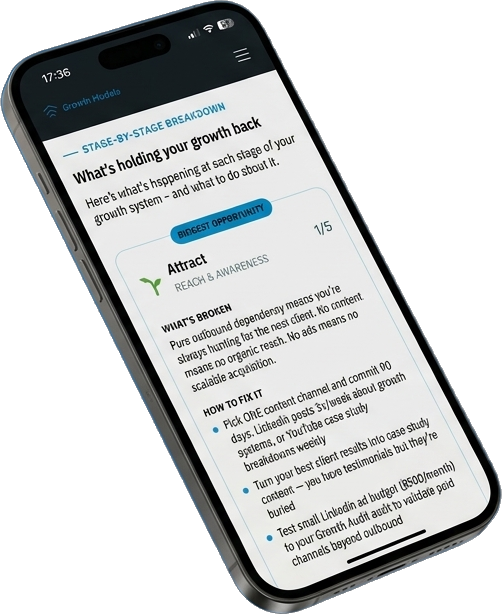
Not sure where your conversion system is leaking? Take the free growth diagnostic. It maps your business against all five ACCER stages and shows you exactly which stage is holding you back.