Cut Customer Churn by 50% With This Sequence
Picture your revenue as a bucket. You spend all your time, money, and energy pouring new customers in the top. Ads, funnels, content, outreach. All the sexy acquisition stuff.
But the bucket has a hole in the bottom.
For every four customers you pour in, three of them leak out. Gone. Never to be seen again. And nobody notices because everyone is too busy staring at the top of the bucket.
That hole is churn. And it is the silent killer of otherwise good businesses.
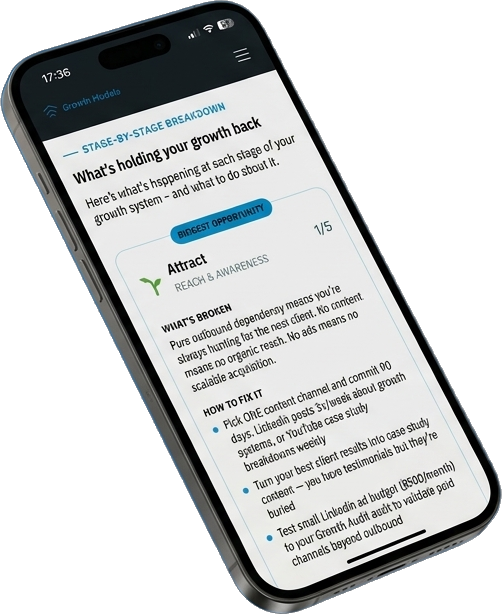
Get a free five-step strategy to grow your business more profitably
Answer a few questions about how you get and keep customers, and get a detailed report on the handful of actions that'll grow your business more profitably. Free, about five minutes.
Why Churn Costs You More Than You Think
Most people think of churn as a subscription problem. SaaS companies. Membership communities. Recurring revenue models. But churn affects every business that sells anything online. Course creators, coaches, consultants, agencies. If people are not coming back to buy from you a second and third time, you have a churn problem.
Here is why it matters so much.
Every customer has a payback period. You spend money to acquire them. Then you need them to pay you enough, over time, to cover that cost and turn a profit. If your cost per acquisition is, say, $50, and a customer needs to pay you three times before you break even, they need to stick around for all three payments.
If they leave after two? You have not just lost a customer. You have lost money. That person cost you more than they ever gave back. Multiply that across hundreds of customers and you start to see the damage.
This is why the smartest businesses fix the hole before they throw more people in.
The Root Cause: A Value Mismatch
People churn for one reason. They are not getting enough value back for what they are paying.
It really is that simple. If you charge someone $100, you need to deliver at least $101 of perceived value. Ideally, $200 or more. At that point, leaving feels like a bad deal for the customer. They are paying $100 and getting $200 back. Why would they ever stop?
Think of it this way. If someone said “pay me $100 a month and I will give you $150 back every month,” you would keep paying. Obviously. If they said “pay me $100 and I will give you $100 back every three months,” you would be gone.
The maths is simple. The execution is where people get stuck.
Here is the thing. The value is often there. Buried inside the product. The problem is not that the product is bad. The problem is that most customers never experience the best parts of it. They sign up, get overwhelmed, poke around for a bit, never find the features or lessons that would actually change things, and leave.
Your job is to make sure every new customer experiences the highest-value parts of what you offer as fast as possible.
The Highest-Value-Feature Sequence
I first built this sequence when working with a fintech scaleup. We implemented it and slashed their churn by roughly 50%. It is a three-step process, and it works for SaaS, communities, courses, coaching programmes, and service businesses.
Step 1: Identify Your Power Users
You need to find the customers who are getting the most value right now. These are the people with two traits:
- High engagement. They log in regularly, use the product frequently, ask good questions, and actively participate.
- High lifetime value. They have been paying you for a long time, or they have bought multiple products from you.
These are your best customers. The advocates. The ones who would fight for your brand. You want to understand exactly what makes them different from the people who churn after 30 days.
Step 2: Interview Them
Not a survey. Not a feedback form. Actual one-to-one conversations.
When we did this at the fintech company, we spoke to around 25 power users. The goal was to understand:
- Which features do they value most? What specific part of the product has saved them time, saved them money, or made things simpler?
- What tangible results have they gotten? Not vague answers. Specific numbers. “20% increase in revenue.” “Cut admin time by 3 hours a week.” Real outcomes.
- What was the before-and-after transformation? Where were they before they started using the product, and where are they now?
- How are they actually using those features? The use cases. The workflows. The specifics.
You are looking for patterns. If 20 out of 25 people say the same feature changed everything for them, that is your answer.
Step 3: Build a 7-Day Onboarding Sequence
This is where the magic happens. You take everything you learned from those interviews and build a seven-message onboarding sequence that pushes every new customer towards the highest-value features.
These messages can be emails, in-app notifications, DMs, WhatsApp messages. Whatever channel your customers pay attention to.
The key principles:
- Make it stupidly easy. People are overwhelmed when they first sign up. Do not give them 50 things to explore. Give them one or two.
- Use social proof from your power users. “Most of our best customers say this feature made the biggest difference. In fact, 20% of our customers see a 50% increase in X by doing this.”
- Give step-by-step instructions. Click here. Tick that. Do this. Remove every possible point of friction.
- Front-load the value. If someone is on a 7-day trial, they need to experience more value in those seven days than the first full-price payment would cost them. Make the decision to stay a no-brainer.
The entire goal of this sequence is to get people to the “aha moment” before they have a chance to churn. Once they have experienced the real value of what you offer, staying becomes the default.
Why Most Businesses Get This Backwards
Most businesses pour money into acquisition. More ads. More content. More traffic. More leads. And that is fine. Getting more people through the door matters. But if your retention is broken, more traffic just means more people leaking out the bottom of the bucket.
This is the equivalent of turning the tap on full blast while ignoring the open drain. You are working harder and harder just to stay in the same place.
Fix the hole first. Then scale.
When you plug churn and then increase acquisition, the gains compound. Every new customer you bring in stays longer, pays more, and becomes a candidate for higher-ticket offers. That is how you build a growth system that actually scales.
This Works Beyond Subscriptions
You do not need to run a subscription business for this to apply.
Course creators can use the same sequence to get students to complete the highest-impact lessons first. That leads to better results, better testimonials, and a higher chance they come back for the next course.
Coaches and consultants can identify the one framework or approach that consistently delivers the biggest wins for clients. Then front-load that in every engagement.
Agencies can look at which deliverables drive the most measurable ROI for clients and prioritise those in the first 30 days.
The principle is always the same. Find what your best customers value most. Make sure every new customer experiences that thing as quickly as possible.
The Payback Period Problem
Here is where churn connects to your broader growth marketing strategy.
Every customer has a payback period. The time it takes for you to recoup your acquisition cost and start making profit. If someone churns before that payback period is up, you have not just failed to grow. You have actively lost money.
When churn is high, you need more payments per customer to break even. That means longer payback periods. Longer payback periods mean you need more cash upfront to fund acquisition. Which means you cannot scale.
When churn is low, customers pay you back faster. You free up cash to reinvest in acquisition. You can afford to run profitable ad campaigns that bring in even more customers. And since those customers now stick around, the whole thing compounds.
Low churn does not just save money. It funds growth.
The Sequence in Practice
Here is what a 7-day highest-value-feature sequence might look like for a SaaS product where power users identified “automated reporting” as the feature that saves them the most time:
Day 1: Welcome + “Here is the one thing our best customers do first” (link to set up automated reporting)
Day 2: Quick win: “Set up your first automated report in 3 minutes” (step-by-step walkthrough)
Day 3: Social proof: “How [customer name] saves 5 hours a week with automated reports”
Day 4: Advanced tip: “Three report templates our power users swear by”
Day 5: Outcome reminder: “Customers who use automated reporting are 3x less likely to cancel. Here is why.”
Day 6: Troubleshooting: “Stuck? Here is how to fix the most common setup issues”
Day 7: Next step: “Now that reporting is running, here is the next feature to unlock”
Seven messages. All pushing the same direction. All designed to get the customer to the value as fast as possible.
Fix the Bucket, Then Fill It
Churn is not glamorous. Nobody posts about their onboarding sequence on LinkedIn. But it is one of the highest-ROI activities in your entire business.
The sequence is straightforward. Find your power users. Interview them. Build an onboarding sequence that pushes every new customer toward the features, lessons, or approaches that deliver the most value.
Once that hole is plugged, every other part of your growth system works harder. More of the customers you acquire stick around. More of them ascend to higher-ticket offers. More of them refer others. The whole engine compounds.
Stop pouring water into a leaky bucket. Fix the hole first.
Not sure where your business is leaking the most revenue? Take the free growth diagnostic. It maps your business against all five ACCER stages and shows you exactly where to focus first.