How to Write a Value Proposition That Actually Converts
Your value proposition is the single most important piece of copy on your website. It’s the first thing visitors read. It determines whether they stay or leave. And most companies get it completely wrong.
Not because they’re bad at writing. Because they’re answering the wrong question.
A value proposition doesn’t answer “what do we do?” It answers “why should I care?” Those are different questions with very different answers.
If your current value prop sounds like “We help businesses grow through innovative marketing solutions,” you’ve answered the wrong question. That sentence could describe 10,000 companies. It tells the reader nothing about why you’re different, what specific result they’ll get, or why they should pick you over everyone else.
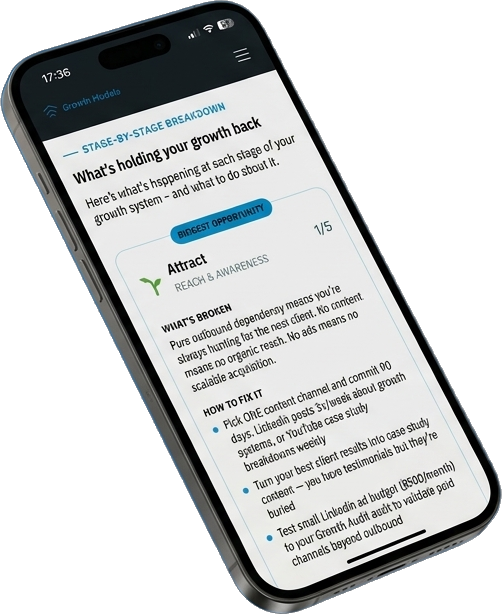
Get a free five-step strategy to grow your business more profitably
Answer a few questions about how you get and keep customers, and get a detailed report on the handful of actions that'll grow your business more profitably. Free, about five minutes.
Let’s fix that.
What a Value Proposition Actually Is
A value proposition is a clear statement that explains three things:
- What result you deliver (the outcome, not the process)
- Who it’s for (specific enough to exclude people)
- Why you’re different (what makes your approach distinct)
That’s it. Not a mission statement. Not a tagline. Not a paragraph about your company values. A direct answer to the question every visitor is asking: “Is this for me, and will it solve my problem?”
Why Most Value Propositions Fail
They’re written for the company, not the customer
“We’re a leading provider of integrated marketing solutions leveraging data-driven insights to drive measurable business outcomes.”
Who wrote that? Someone in a meeting room trying to sound impressive. Who does it help? Nobody. The customer doesn’t care that you’re “leading” or that your solutions are “integrated.” They care whether you can fix their problem.
They’re too vague to be useful
“We help you grow.” Great. So does eating vegetables. What specifically do you do? For whom? How fast? What changes in my business after working with you?
Vagueness isn’t strategy. It’s a sign that the company hasn’t figured out what they actually sell.
They try to appeal to everyone
The moment you try to speak to everyone, you resonate with nobody. “For businesses of all sizes across all industries” is not targeting. It’s surrender.
The best value propositions are specific enough that some people read them and think “that’s not for me.” Good. Those aren’t your customers. The people who read it and think “that’s exactly what I need” are.
They lead with features instead of outcomes
“Our platform integrates with 200+ tools and offers real-time analytics dashboards.”
The customer doesn’t wake up thinking “I need more integrations.” They wake up thinking “I’m wasting 4 hours a week pulling reports from 6 different platforms.” Lead with the second one.
The Framework That Works
Here’s a practical framework for building a value proposition that converts. I’ve used this across dozens of client projects with SaaS companies, service businesses, e-commerce brands, and B2B consultancies. It works across all of them because it’s rooted in customer thinking, not company thinking.
Step 1: Identify the Specific Result
Not what you do. What changes for the customer.
Bad: “We offer growth marketing services”
Good: “We build a complete growth system in 90 days that generates predictable pipeline”
The first one describes your activity. The second describes the customer’s outcome. Start with the outcome, always.
Ask yourself: after working with us (or using our product), what is measurably different in the customer’s business?
If you can’t answer that specifically, you need to talk to more customers before writing your value prop.
Step 2: Name Your Customer
Not “businesses.” Not “companies.” Not “professionals.” Specific.
Bad: “For businesses looking to grow”
Good: “For companies doing $1M-$10M that have hit a growth ceiling”
Naming your customer does two things. It makes the right people lean in (“that’s me”). And it makes the wrong people self-select out, which saves everyone time.
The more specific you are, the more powerful the value proposition becomes. “For e-commerce brands doing $2M-$10M that are spending on ads but can’t scale profitably” is infinitely more compelling than “for online businesses.”
Step 3: State What Makes You Different
Not better. Different. “Better” is subjective and unprovable. “Different” is factual and verifiable.
Bad: “We’re the best growth marketing agency”
Good: “We build your system in 90 days and leave. No retainer, no dependency.”
Your differentiator should pass the “opposite test.” If the opposite of your differentiator is something nobody would claim, it’s not a real differentiator.
“We deliver high-quality work.” The opposite is “we deliver low-quality work.” Nobody claims that. So “high-quality” isn’t a differentiator.
“We build your system and hand it over. You own everything. No retainer.” The opposite is “we keep running your marketing on retainer indefinitely.” Plenty of agencies claim that. So this is a genuine differentiator.
Step 4: Add a Proof Point
Claims without evidence are just opinions. Add one specific proof point that makes the value proposition credible.
Without proof: “We build growth systems for scaling companies”
With proof: “We build growth systems for scaling companies. 6,645 leads at $3.75 CPL for our last client.”
One concrete number does more for credibility than three paragraphs of company backstory.
Step 5: Assemble It
Put the pieces together in this order:
[Result] + [For whom] + [Differentiator] + [Proof]
Example:
“Growth systems that generate predictable pipeline for companies doing $1M-$10M. Built in 90 days. You own it. It runs without us. Our last build generated 6,645 leads at $3.75 each.”
That’s a value proposition. It’s specific. It names the customer. It states the outcome. It differentiates. And it proves it.
Real Examples (Good and Bad)
Example 1: SaaS Company
Before: “The all-in-one platform for modern businesses”
Problem: Vague. Doesn’t specify who, what result, or what makes it different.
After: “Project management that keeps remote teams on deadline. 40% fewer missed deadlines in your first quarter.”
Why it works: Specific audience (remote teams), specific result (fewer missed deadlines), specific timeframe (first quarter), and a proof point.
Example 2: Service Business
Before: “We provide comprehensive marketing solutions”
Problem: Could describe any marketing company on earth.
After: “We build your entire marketing system in 90 days and hand it over. One senior operator, not an agency assembly line. Fixed price. No retainer.” (Sound familiar? That’s the Growth Models approach.)
Why it works: Specific deliverable (entire marketing system), clear differentiator (one person, not agency), clear business model (fixed price, no retainer).
Example 3: E-commerce Brand
Before: “Premium products for the modern consumer”
Problem: Says nothing specific about the product, the customer, or the benefit.
After: “Protein that doesn’t taste like chalk. 30g per serving, 3 ingredients, tested by 12,000 athletes.”
Why it works: Addresses the main objection (taste), states the key specs (30g, 3 ingredients), and adds social proof (12,000 athletes).
Testing Your Value Proposition
Once you’ve written it, run it through these four tests:
The “So What?” Test
Read your value proposition out loud. After each sentence, ask “so what?” If you can’t answer with something specific that matters to the customer, rewrite it.
The Competitor Swap Test
Replace your company name with a competitor’s. If the value proposition still works for them, it’s not specific enough. Your value prop should only be true of you.
The Pub Test
Would you say this to a friend at the pub if they asked what your company does? If it sounds like corporate jargon when spoken out loud, rewrite it in the words you’d actually use in conversation.
The Five-Second Test
Show your homepage to someone who’s never seen it. After five seconds, ask them what the company does and who it’s for. If they can’t answer, the value proposition isn’t clear enough.
Where to Use Your Value Proposition
Your value prop isn’t just for the homepage hero section. It should inform copy across your entire site:
Homepage: Full value proposition above the fold
Landing pages: Adapted for the specific offer, but rooted in the same core message
Email subject lines: The result or differentiator pulled into a single line
Ad copy: The customer + result in the character limit
Sales calls: Your opening statement when someone asks what you do
Social profiles: Compressed into one line
Consistency matters. If your homepage says one thing and your landing page says another, visitors feel the disconnect even if they can’t name it.
The Biggest Mistake Companies Make
They write the value proposition once and forget about it.
Your market changes. Your customers evolve. Your product improves. Your value proposition should be a living document that gets tested and refined based on what converts, not what sounds good in a team meeting.
Review it quarterly. Test variations on your landing pages. Pay attention to the words your best customers use when they describe why they bought from you. Those words are often better than anything you’d write from scratch. If you’re working with a copywriter on this, make sure they understand research-first writing. We cover what to look for in our guide on hiring a copywriter who drives revenue.
Start Here
If you’re running a company at $1M-$10M and your value proposition doesn’t clearly state what result you deliver, for whom, and why you’re different, fix it this week. It affects every page on your site, every ad you run, and every sales conversation you have. And if you’re evaluating marketing spend to get help with this, our growth marketing pricing guide breaks down what each model costs and what you get.
And if the reason your value proposition is unclear is because your whole growth system is unclear, get a free Growth Audit. We’ll map where the system is broken and what it would take to fix it. You keep the audit whether you work with us or not.