How to Create Digital Products That Sell: The NESB Offer Framework
Most people who try to create digital products that sell end up with something nobody buys. Not because the product is bad. Because the offer is generic.
It is built for everyone, which means it resonates with no one. No specificity. No angle. No reason for anyone to care.
The fix is not more features, more bonuses, or a lower price. The fix is building your offer around a framework that forces specificity at every level. Transformation first. Then four filters that determine whether people actually reach for their wallets.
Here is how to do it.
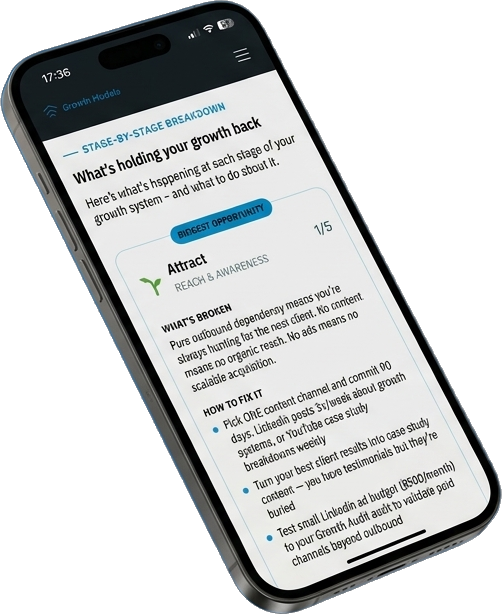
Get a free five-step strategy to grow your business more profitably
Answer a few questions about how you get and keep customers, and get a detailed report on the handful of actions that'll grow your business more profitably. Free, about five minutes.
Why Generic Digital Offers Do Not Sell
A generic offer is one that could apply to anyone. “Lose weight.” “Grow your business.” “Get more leads.”
These statements are true. They are also completely forgettable. When your offer sounds like every other offer in the market, you are competing on price. And competing on price is a race you do not want to win.
Specific offers for specific people. That is the foundation. Before you touch anything else in this article, you need a clearly defined ideal customer. Not a vague demographic. A real person with real problems and a real desired outcome.
If you have not done that work yet, start with the free growth diagnostic to identify where your pipeline is leaking. Then come back here.
A specific ICP leads to a specific offer. And a specific offer is one that actually converts.
How to Create Digital Products Around Transformation, Not Features
The single biggest mistake in digital offer creation is leading with features.
“12 hours of video content. 47 templates. Weekly group calls.” Nobody cares. Nobody buys a course because it has more hours of video. Nobody hires a consultant because they get an extra call per week.
People buy transformation. They are here, and they want to be there. Your offer is the bridge.
Features and benefits matter. But they are secondary. The transformation is what gets people in the door.
Compare these two offers:
- Generic: “I will help you lose weight.”
- Specific: “I will help you lose 50 pounds in 6 months.”
The second version is better because it gives the buyer something concrete to envision. What would I look like 50 pounds lighter? That mental image does more selling than any feature list ever could.
But you can go deeper. Ask: why do they want that transformation?
The Three Drivers Behind Every Purchase
Almost every buying decision traces back to one of three motivations:
- Status. They want to feel good about themselves. They want other people to notice. The person who wants to look incredible at a friend’s wedding. The founder who wants to be known as the top earner in their group.
- Lifestyle. They want to unlock experiences. The person who wants to hike every weekend without needing three weeks to recover. The business owner who wants to travel more and needs revenue to fund it.
- Security. They want to protect their future. The grandparent who wants to be around for their grandkids. The professional who wants their retirement sorted.
The person who wants to buy a Lamborghini and the person who wants to invest safely for retirement both want more money. But they need completely different messaging, positioning, and offer framing.
Knowing which driver sits behind your ICP’s desired transformation changes everything about how you create profitable offers.
The NESB Framework: Four Filters for Digital Offer Creation
Once you have the transformation and the motivation, run your offer through four filters. This is adapted from Kyle Milligan’s copywriting formula, but it works just as well for offer design.
Your offer needs to feel: New. Easy. Safe. Big.
New: People Are Drawn to Novelty
Humans are curious. A novel approach gets attention in ways that “the same thing everyone else is doing” never will.
Look at the diet industry. Every few years, a new approach appears. It does the same thing as every other diet. Helps people eat fewer calories. But because it is packaged as something new, people flock to it.
“Revolutionary new system” outperforms “keep doing what you have been doing” every single time. If you can position your method, your angle, or your mechanism as something the market has not seen before, your offer instantly becomes more compelling.
This is where your unique mechanism becomes critical. The Rule of One says you need one clear differentiator. That mechanism is what makes your offer feel new, even if the underlying result is not.
Easy: Less Effort for the Same Result
Given two paths to the same outcome, people will always choose the easier one. Less effort. Lower sacrifice. Fewer things to give up.
People pay for shortcuts. That is not cynical. It is human nature. Your offer should communicate that the path to their transformation requires less effort than they expect.
This does not mean lying about what is involved. It means genuinely finding ways to make the process simpler. Remove unnecessary steps. Provide templates. Automate the boring parts. Build the system so they do not have to.
Safe: Minimise the Perceived Risk
People avoid unnecessary risk. If your offer feels like a gamble, they will not buy. Full stop.
This is where social proof earns its keep. “Join 10,000 other people who have succeeded with this system” tells the buyer they are not a guinea pig. They are not the first person through the door. It is proven. It is tested. The risk of failure is low.
Guarantees, case studies, testimonials, and real numbers all reduce perceived risk. The upside should massively outweigh any potential downside of taking action.
If you want to see how this works in practice, look at the psychology behind offers that make customers reach for their wallets.
Big: Nobody Works Hard for Small Results
Everyone knows there will be effort involved. Everyone knows there is some risk. So why would anyone put in that effort and take that risk for a small outcome?
“Lose 5 pounds” does not excite anyone. “Get your dream body” does. “Earn an extra thousand a year” is forgettable. “Build a system that generates a million in revenue” is worth paying attention to.
Make the promised outcome big enough that the effort and risk feel justified. This is not about making unrealistic claims. It is about framing the genuine result in the most compelling way possible.
A Real-World Example: Why Ozempic Exploded
Ozempic is a perfect case study for the NESB framework in action.
- New: A brand new drug. Novel approach to weight loss. Not the same old advice about diet and exercise.
- Easy: One injection versus daily exercise, calorie counting, meal prep, and saying no to everything enjoyable.
- Safe: Approved by health authorities. Millions of people already using it.
- Big: People losing significant amounts of weight. Visible, dramatic results.
It hit all four filters. That is why it dominated the market. Your digital offer might not be a pharmaceutical product, but the same principles apply.
How Timelines Affect Digital Product Sales
People are impatient. If two offers promise the same result and one delivers it in six months while the other takes a year, the six-month option wins every time.
Most buyers are not thinking about where they will be in a year. They are thinking about next month.
Shorten the timeline wherever you honestly can. But what if the result genuinely takes time? You cannot promise someone will lose 50 pounds in a week. Making that claim undermines everything.
The solution: build milestones.
Front-Load Early Wins
Break the big transformation into smaller progress markers. Future-pace their success so they can see the path clearly.
Month one: lose the first 5 pounds. Month two: hit 20. Month three: reach 30. Each milestone keeps them motivated. Each small win reinforces that they made the right decision.
The initial milestones matter most. The faster someone gets a result with your offer, the more likely they are to stay.
I consulted with a fintech company to address their churn rate. We identified what I later called their “highest value feature.” The feature that power users loved and churning users never set up. We built an onboarding sequence that pushed new users to activate that feature within seven days.
Churn dropped off. Not because the product changed. Because users hit their first progress milestone faster.
Your offer needs the same thing. An early win. Something small but meaningful that happens quickly. It does not need to be the full transformation. It just needs to prove they are on the right track.
This principle maps directly to the Engage stage of the ACCER growth framework. Getting customers to their first win quickly is how you build retention and lifetime value.
How to Price Digital Products: The 10:1 Value Ratio
The value of your offer should massively outweigh the cost. A good guideline is 10:1.
If the result is worth a million pounds, charging a hundred thousand makes sense. The buyer still walks away with nine hundred thousand in value. That is a trade anyone rational would make.
This works at every level. If someone earns fifty thousand a year, five thousand spread over twelve months is roughly 10:1 against their income.
Two pricing principles to remember:
- Do not undercharge. Most people price too low. When the cost is too small, buyers do not value what they get. They do not do the work. They do not get the result. And then they think the product was the problem.
- The price should sting slightly. Not crippling. But enough that they are motivated to actually use what they bought. A little financial commitment creates accountability.
The balancing act is charging what the offer is worth (good for you), delivering massive ROI (good for them), without pricing people out or charging so little they do not take it seriously.
For more on structuring price points that work, see the breakdown of self-liquidating offers in 2026.
Putting It All Together: The Offer Assembly Process
Here is the complete process for building a digital offer that actually sells:
- Define your ICP. Not a demographic. A real person with specific problems, specific goals, and specific blocks stopping them from getting there.
- Identify the transformation. Where are they now? Where do they want to be? Why do they want it (status, lifestyle, or security)?
- Run it through NESB. Is the offer new? Is it easy? Is it safe? Is it big? If it is missing one of these, fix it.
- Set the timeline. How fast can they realistically get the result? Build milestones. Front-load early wins.
- Price at 10:1. The perceived value should be ten times the cost. Charge enough that they take it seriously.
Skip any of these steps and you end up with a generic offer that competes on price. Follow all of them and you have something that practically sells itself.
Frequently Asked Questions About Creating Digital Offers
What is the most important element when you create digital products that sell?
The transformation. Features and benefits matter, but people buy the outcome. They are paying for the bridge between where they are now and where they want to be. Get the transformation right and everything else becomes easier to position.
How do I price my digital offer if the result is hard to quantify?
If the result does not have a direct financial value, think about what it is worth to the buyer. How much would they pay to solve that problem permanently? Use their income as a baseline and aim for roughly 10:1. The price should feel like a clear trade in their favour, but high enough that they commit to doing the work.
Can I use the NESB framework for service-based offers, not just digital products?
Yes. The framework applies to any offer. Consulting, coaching, retainers, software, physical products. If it solves a problem for a specific person, these four filters (New, Easy, Safe, Big) will make it more compelling. The principles do not change based on delivery method.
What if my digital product takes months to deliver results?
Build milestones and front-load early wins. The faster someone sees progress, the more likely they are to stay engaged. You cannot promise overnight results if they are not realistic. But you can break the journey into smaller checkpoints that prove they are on the right track from week one.
How specific should my offer be if I want to reach a large audience?
As specific as possible. This feels counterintuitive, but specific offers attract more buyers than generic ones. “Lose 50 pounds in 6 months without exercise” will outsell “lose weight” every single time. Specificity builds trust, creates urgency, and helps people self-select into your offer.
Not sure whether your current offer is the bottleneck, or if the problem is somewhere else in your growth system? Take the free ACCER diagnostic to find out exactly where to focus first.