How to Get Clients From Facebook Groups Without Getting Banned
Free online communities are full of your ideal customers. Facebook groups, LinkedIn groups, School communities, Circle, Reddit. Thousands of people sitting there, ready to buy.
And yet most people who try to get clients from Facebook groups end up banned within a week.
Not because the strategy is wrong. Because the execution is. They spam promotional posts, blast cold DMs, and wonder why nobody engages. That approach has never worked. It certainly does not work now.
There is a better way. A permission-based method that starts real sales conversations within 24 hours, generates revenue from day one, and actually builds your reputation inside the community rather than destroying it.
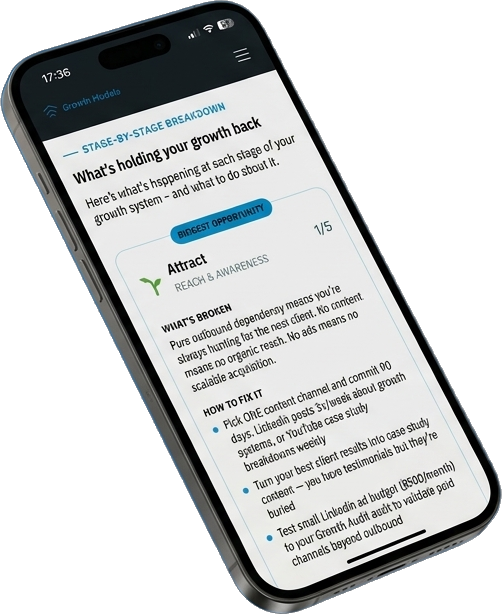
Get a free five-step strategy to grow your business more profitably
Answer a few questions about how you get and keep customers, and get a detailed report on the handful of actions that'll grow your business more profitably. Free, about five minutes.
It is called the spearfishing method. And it works in any free community where your ideal customers gather.
Why Most People Fail When They Sell in Online Communities
Before we get into what works, let us look at what does not. Three mistakes kill almost every community-based client acquisition attempt.
1. Treating the community like an ad platform
They join a group, design a graphic, and spam it everywhere. “Hey, if you want to solve this problem, click here!” Nobody engages. Nobody cares. You are interrupting people who came for value, not ads.
2. Blasting cold DMs
The classic SMMA playbook. “Hey, how’s your business going?” If I get a message like that, I am done with the conversation immediately. Everyone knows the pitch is coming. It is transparent, annoying, and it does not convert.
Even if you send 5,000 messages a day, the close rate is abysmal. The cost per acquisition is terrible. And it does not scale without hiring a team or spinning up dozens of email accounts and warming each one individually.
3. Not building credibility first
Even if you could get away with a straight promotional post or a cold DM, you have zero reputation. Nobody in that community knows who you are. Why would they trust you with their money?
These three mistakes all share the same root cause. They put your needs ahead of the community’s needs. The spearfishing method fixes that.
The Spearfishing Method: How to Get Clients From Free Groups
Rather than going for mass reach and trying to market to everybody in a group, spearfishing is a targeted, permission-based approach. You are not casting a wide net. You are picking individual people who have already shown interest.
Four steps. That is it.
- Find a good community
- Write a value post (with a specific structure)
- Identify the engagers
- Follow up with a warm DM
Let us break each one down.
Step 1: Find the Right Community for Your ICP
Not all communities are equal. A generic entrepreneur group with 100,000 members is almost always worse than a niche community of 2,000 people who match your ideal customer profile.
Here is what to look for.
Specificity over size
If you sell local SEO, do not join a general entrepreneurship community. Join a group called “Local SEO Tips for Small Businesses” where the members are shop owners trying to drive foot traffic. That is where your buyers are.
Engagement rate
Facebook groups are great for this because they show you how many posts have been made in the last day, week, and month before you even join. If a group has fewer than one post per day, skip it. You want communities with multiple posts every single day.
Spam rate
High post volume means nothing if every post is someone hawking their offer. Go into the group and scroll through the recent posts. If most of them are promotional spam, move on. You want communities where people actually have conversations.
The ideal community is specific to your market, has daily engagement, and has genuine discussions rather than a wall of self-promotion.
Step 2: Write a Value Post That Sells Without Selling
This is where most people get the method wrong. They think “value post” means a quick tip or a motivational quote. It does not.
Your value post needs to do three things simultaneously.
Demonstrate expertise
Do not write generic advice. Write from experience. “Here is how I increased sales by 20% for [type of business]” is infinitely more compelling than “If you are struggling with sales, try this.” One shows you have done the work. The other could be written by anyone.
Reframe how they think about the problem
You want people to read your post and think: “I have been doing this wrong.” Challenge the conventional approach. Show them that the way they are currently doing things is costing them results, and that a better way exists.
Give the “what” but not the “how”
This is the crucial distinction. Share the insight. Explain the theory. Show the results. But do not give them the full playbook.
For example, you might write a post about why free lead magnets attract freebie-seekers who never buy, and why charging even a small fee up front filters for serious buyers. That is a genuine insight. It reframes their thinking. It demonstrates expertise. But they still do not know how to set up that system. That is what your paid offer covers.
This is not manipulative. You are giving genuine value that changes how they think. You are just not doing the entire job for free.
Step 3: Identify and Engage With the Right People
Once your value post is live, two things need to happen.
Respond to every single comment
This serves two purposes. First, every comment and reply feeds the algorithm. A post with 60 comments (even if 30 of those are your replies) gets pushed higher in the feed and shown to more people. Second, it builds social proof. When someone stumbles across your post and sees a genuine conversation happening underneath it, they are far more likely to read it and engage themselves.
Track who has both liked AND commented
These are your warm leads. Someone who just liked might have been scrolling passively. But someone who took the time to like and comment has actively raised their hand. They are telling you: “This resonated with me. I want more.”
Keep a simple list of these people. You will need it for the next step.
Step 4: The Warm DM That Converts Without Being Pushy
This is not a cold DM. That distinction matters enormously.
A cold DM lands in someone’s inbox from a stranger with an obvious pitch. A warm DM lands from someone who already provided value, to someone who already showed interest. The dynamic is completely different.
Here is the structure:
“Hey, I saw that you liked and commented on my post about [topic]. Really appreciate the engagement. Just in case you are interested, I have a [product/offer] that walks through exactly how to implement this. No pressure at all. Here is the link if you want to check it out. Any questions, just let me know.”
That is it. No hard sell. No manufactured urgency. No “I noticed you’re a founder, can I ask you a question?” opener that everyone sees through immediately.
You are following up with someone who already engaged with your thinking. You are offering something relevant to the problem they clearly care about. And you are giving them a zero-pressure way to say yes or no.
You would be amazed at how many people take you up on this.
Why Low-Ticket Offers Work Best With This Method
One value post is not enough to sell a $5,000 retainer. You have banked some goodwill, but not that much. The trust gap between “great post” and “here is my credit card for five thousand pounds” is massive.
That is why this method pairs best with a low-ticket front-end offer. Something at $1, $10, $27, $47. Small enough that saying yes is easy. Big enough that they are a buyer, not a freebie-seeker.
The advantages of going low-ticket first:
- You can close the sale entirely through chat. No booking calls. No sales presentations. No extra steps that create friction and kill conversion.
- It validates your offer fast. If people in your target community will not pay $10 for your solution, they certainly will not pay $2,000. You learn that in days, not months.
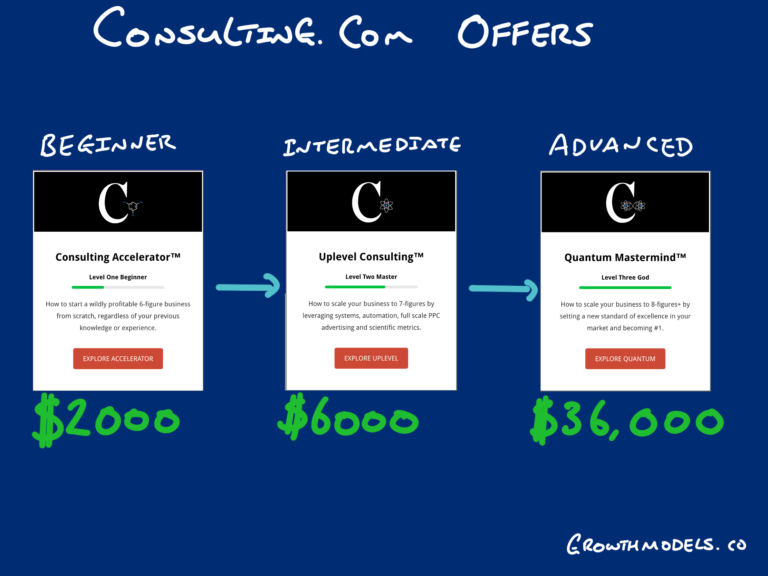
- It creates buyers you can ascend later. Someone who buys your $27 product today is infinitely more likely to buy your $2,000 programme next month than someone who downloaded a free PDF.
- It funds future acquisition. The revenue from spearfishing can fund your first ad campaigns to scale beyond community-based selling.
Think of it as the front door to your business. The real money comes from what happens after they walk through it. Your Capture and Convert stages handle the initial sale. Your Engage stage handles the ascension.
Building Long-Term Compound Growth From Communities
Spearfishing is not a one-off tactic. It compounds.
The first time you post in a community, nobody knows you. Your reach depends entirely on the quality of that single post. But do this once a week or once a month, and something shifts.
People start to recognise your name. “Oh, that is Pete. He always posts great stuff about email marketing.” Your posts get more engagement because you have built a track record. Your DMs convert at a higher rate because prospects have seen three or four of your posts before you ever reach out.
That is the difference between a tactic and a system for turning cold traffic into clients. A tactic gets you one result. A system compounds over time.
And once you have proven your offer converts through community-based selling, you have the confidence and the data to scale with paid ads. The spearfishing revenue funds the ad spend. The ad spend scales what you already know works.
Where This Method Works (Beyond Facebook Groups)
Facebook groups are the most common starting point, but this method is platform-agnostic. It works anywhere your ICP gathers in communities:
- Reddit subreddits (be careful with self-promotion rules, but value posts thrive)
- School communities (smaller but often higher quality engagement)
- Circle communities (common in SaaS and education niches)
- LinkedIn groups (less active but can work for B2B services)
- Slack channels (especially industry-specific ones)
The platform does not matter. The principle does. Find where your people are. Provide genuine value. Follow up only with people who show interest.
If you want to go deeper on this, the spearfishing with dynamite method takes this same principle and adds a paid amplification layer to reach even more people in the same communities.
Frequently Asked Questions
How often should I post in a free community without looking like a spammer?
Once a week is the sweet spot for most communities. Some larger, more active groups can handle two posts per week. The key is that every post must be genuinely valuable. If you are providing real insights and engaging in the comments, the community will welcome your contributions rather than flagging them.
Can I use this method to sell high-ticket services directly?
Not from a single post. One value post builds some trust, but not enough to close a $5,000 deal. Use spearfishing to sell a low-ticket front-end offer ($10 to $50), then ascend buyers through your email sequence and sales process. The people who buy your $27 product are your best candidates for high-ticket conversations later.
What if the community has strict rules against any kind of promotion?
The value post itself contains zero promotion. It is purely educational. The follow-up DM only goes to people who engaged with your post. You are not breaking any community rules because you are not promoting in the group. You are having a private conversation with someone who showed interest in your expertise.
How quickly can I expect results from spearfishing?
You can generate sales within 24 hours of your first value post if the community is active and you follow up promptly with engagers. The method works fast because you are reaching people who are already gathered around the problem you solve. There is no warming up period or audience-building phase required.
Start Fishing in the Right Waters
Community-based client acquisition works when you respect the community. Post value. Build credibility. Follow up with the people who raise their hand. Keep the first offer small enough that saying yes is easy.
No cold DMs. No getting banned. No spamming graphics that nobody asked for.
Just a predictable system for turning free communities into a pipeline of buyers who already trust your thinking.
Not sure which part of your growth system needs work first? Take the free growth diagnostic. It maps your business against all five ACCER stages and shows you exactly where to focus.