Your ICP Is Costing You Money. Here’s the Fix.
If you’re struggling to land consistent clients (high-ticket or otherwise), the problem probably isn’t your offer. It’s not your sales skills. It’s not even your marketing.
It’s who you’re talking to.
Most businesses have a vague, generic ideal customer profile that makes targeted marketing nearly impossible. And then they wonder why nothing converts.
Specificity is the fix. Here’s how to get it right.
Get a free five-step strategy to grow your business more profitably
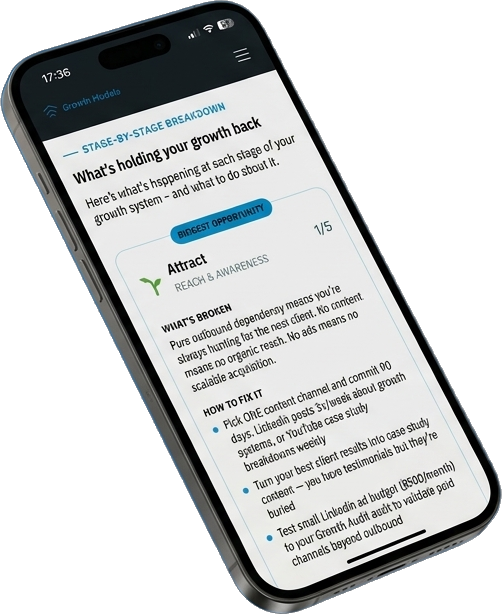
Answer a few questions about how you get and keep customers, and get a detailed report on the handful of actions that'll grow your business more profitably. Free, about five minutes.
Why Generic ICPs Kill Your Growth
A generic ideal customer profile creates a cascade of problems. When you’re trying to appeal to everyone, your messaging has to stay broad enough to not alienate anyone. Broad messaging sounds like everyone else’s messaging. And messaging that sounds like everyone else’s gets ignored.
A defined ICP does the opposite. It gives you:
- Clearer messaging. You can speak directly to specific problems, in specific language, that specific people recognise as theirs.
- Built-in targeting. You know where these people are, what they read, what platforms they use, and what job titles they hold.
- Faster results. Targeted campaigns to a specific audience convert at multiples of generic campaigns.
- Better referrals. When you serve a tight niche well, those people know others just like them. One client becomes two. Two becomes four.
Here’s the uncomfortable truth most people don’t want to hear: 10 people who can pay are more valuable than 100,000 who won’t.
Most businesses chase mass-market appeal. Content that gets likes and shares from people who will never buy. That’s vanity. The people who actually pay you are a specific subset. Your job is to find that subset and speak directly to them.
The Beachhead Market Strategy
Every business has a total addressable market. The entire universe of people who could theoretically use your product or service.
The problem is that most businesses try to go after the whole thing.
Take health and wellness. A company like Noom has a total addressable market of everyone who wants to lose weight. And at $500 million in annual revenue with massive teams, they can afford to build separate programmes for different segments. People who need to lose 20 pounds before a wedding. People who are clinically obese and need fundamental nutritional change. Semi-pro athletes trying to cut weight for a competition. Each group has different needs, different challenges, different motivations.
Noom can afford to address all of them. You can’t.
And here’s the thing most people miss: even Noom doesn’t market well anymore. They’ve hit a level of market saturation where everyone knows the name. They succeed now in spite of their marketing, not because of it. They’ve earned the right to be generic through years of brand-building and massive spend.
Copying their approach as a smaller business is a recipe for failure. You don’t have their brand equity. You don’t have their budget. You don’t have their 15 years of market presence.
What you need is a beachhead market. One small, specific segment within that total addressable market where you can win decisively.
Instead of “people who want to lose weight,” you target women aged 30 to 40 who want to lose 20 pounds in six months for a specific life event. Now your messaging can be razor-sharp. Your offer can be built specifically for their situation. And everything Noom does badly for this specific group, you do brilliantly.
That’s the beachhead. You capture one small territory completely. Then expand from there.
The ICP Template
Here’s the template that makes this concrete:
“I’m targeting [Role] at [Company/Location] who have [Differentiators] and need [Solution].”
For B2B, it’s role at company. For B2C, it’s title at location. Either way, you need four elements:
- Who they are (role, title, demographic)
- Where they sit (company type, industry, location)
- What makes them different (the differentiators that make them ideal)
- What they need (the specific solution they’re looking for)
Let me show you what this looks like with a real example.
From Zero to Six Figures: A Real ICP in Action
Years ago, running a copywriting business, here was the exact ICP:
“CMOs or VPs of Marketing at marketing software companies who have just raised seed or Series A funding in the last 30 to 60 days, based in the US or UK, who have good but not great copy and need to improve sales pages and email sequences.”
Every element was deliberate.
CMOs or VPs of Marketing because they had the authority to hire an external copywriter without needing five levels of approval.
Marketing software companies because that was the industry where the existing portfolio lived. Brands like Crazy Egg, Olark, BigCommerce. Relevant experience that prospects could verify.
Just raised seed or Series A in the last 30 to 60 days because those companies had fresh capital and investors breathing down their necks. They had a fire lit under them to spend money and get results. Urgency was built into the timing.
Good but not great copy because companies with great copy didn’t need help, and companies with terrible copy didn’t value it enough to pay for external expertise. The sweet spot was people who understood copywriting mattered but knew theirs could be better.
Sales pages and email sequences because that narrowed the service offering to something specific and measurable.
The result? Sending around 100 emails per month to people who matched this profile generated roughly four clients. Two one-time projects and two ongoing retainers. Enough to build a six-figure business as a solo copywriter with Google Docs as the only software cost.
That’s what a properly defined ICP does. It makes your outreach predictable. It makes your pipeline repeatable. It makes growth systematic instead of random.
The Four Questions That Define Your ICP
If you’re not sure where to start, work through these four questions.
1. Who Are They?
Role, title, industry, location, stage of business. Get as specific as you can.
A note on gender and age: these only matter if your offer is specifically designed for a particular gender or age group. If you’re helping elderly people with fitness, age matters. If you’re selling B2B consulting to marketing leaders, whether the CMO is 28 or 52 is irrelevant. The business has the same goal regardless.
Don’t default to demographic data when psychographic and situational data is more useful.
2. What Problems Keep Them Awake at Night?
This is where most people go wrong. They identify the big, vague problem (“their business isn’t growing”) and stop there.
Nobody lies awake at night thinking “my business isn’t growing” in those exact words. What they’re actually thinking is: “I need to land two clients by the end of the month or I can’t make payroll.”
That’s a cause, not a symptom. The symptom is stalled growth. The cause is a specific, concrete, urgent problem that has a deadline and consequences.
Get to the causes. The smaller, sharper problems that create the big one. That’s where your messaging resonates and your offer becomes irresistible.
3. What Transformation Do They Want?
If everything went perfectly for them, what does life look like in three to six months?
Get specific. They’d be earning $20,000 per month. They’d be working no more than five hours a day. They’d have time with their family. They’d have a predictable pipeline that doesn’t require them to hustle for every sale.
Then go deeper. Why do they want that? The emotions matter more than the numbers. A new parent founder doesn’t just want $20K per month. They want the security of knowing they can provide for their family. They want to be present for their child’s early years without sacrificing their business.
When you understand the emotional driver, your messaging shifts from features to feelings. That’s where real connection happens.
4. What’s Stopping Them?
There are three types of blocks:
- Internal blocks: Mindset issues. “I can’t do this.” “I need more experience.” “I’m not ready.” These are perceived barriers, not real ones. Easier to remove.
- External blocks: Real constraints. “There’s no gym near me.” “I don’t have the budget.” “My team doesn’t have the skills.” These require your offer to work around them.
- Perceived vs. real: Understanding the difference changes how you position your solution. Perceived blocks need reassurance. Real blocks need a genuine workaround.
Your offer needs to address all three. Acknowledge the internal doubts. Remove the external barriers. And make it clear which blocks are real and which are just fear.
Start Specific. Grow Outward.
The most common objection to this approach: “But I don’t want to limit myself to such a small group.”
You’re not limiting yourself. You’re focusing yourself.
A defined ICP is not a ceiling. It’s a launchpad. Once you’ve captured your beachhead market, you expand. You take the case studies, testimonials, and social proof from that first group and use them to open the next segment. Then the next. Then the next.
This is exactly how the ACCER framework works at scale. You build a predictable system for one specific audience. You get the Attract, Capture, Convert, Engage, and Refer stages humming for that group. Then you replicate it for the next beachhead.
The copywriting business is a perfect example. Starting with marketing software companies led to referrals within that space. One client’s head of marketing moved to a new company and immediately reached out: “Got time for a new client?” Because the reputation was built within a tight, interconnected group.
That’s the compounding effect of specificity. One client turns into two. Competitors see the results and want the same. People change jobs and bring you with them.
None of that happens when you’re trying to be the copywriter for everyone. Or the consultant for every industry. Or the coach for any business at any stage.
The Bottom Line
Generic ICPs attract generic results. The businesses that grow predictably are the ones brave enough to narrow down, serve a specific market brilliantly, and expand from a position of strength.
You don’t need 100,000 followers who think your content is cool. You need 10 paying clients who see you as the only logical choice for their specific situation.
Define the beachhead. Build the system around them. Own that territory completely. Then grow outward.
Not sure which market segment you should be targeting? Take the free growth diagnostic. It maps your business against all five ACCER stages and shows you exactly where to focus for the fastest results.