The Attention Economy Is Dead. Welcome to Trust.
AI has changed marketing. Not in a subtle, evolving, give-it-a-few-years kind of way. In a right-now, your-old-funnel-is-broken kind of way.
And most businesses haven’t noticed yet.
They’re still running 2020 playbooks. More ads. More outreach. More content. Increase the volume and hope the revenue follows. That used to work. It doesn’t anymore.
Here’s why, and what to do instead.
Get a free five-step strategy to grow your business more profitably
Answer a few questions about how you get and keep customers, and get a detailed report on the handful of actions that'll grow your business more profitably. Free, about five minutes.
The Attention Economy Had a Good Run
For years, the game was simple. Shout the loudest, get seen the most, win the most customers. That was the attention economy. The businesses with the resources to run the most ads, produce the most content, and blast the most outreach generally won. Not because they were better. Because they were louder.
Then AI showed up.
For twenty dollars a month, anyone can match the output that used to require a full marketing team. Anyone can sound like an expert. Anyone can build flashy funnels with clever headlines and polished hooks.
Which means the things that used to make you stand out no longer do. Because everyone’s doing them.
The attention economy is dead. Your prospects are more sceptical than ever. They engage less. They convert less. And the old channels are bleeding out. LinkedIn posts that used to pull 20,000 impressions now get 200. Cold outreach that used to land four clients per hundred emails now barely books a call. Every platform is throttling reach because it can’t tell the difference between genuine content and AI noise.
The Fishing Lake Problem
Think of your market like a fishing lake.
Before AI, only skilled fishermen could fish it. The ones who had built real expertise, set up their kit through genuine experience, and knew how to bait a hook properly. The fish near the surface (the buyers actively looking for a solution) would see that hook and bite. Easy.
Now? Everyone’s fishing. And they’re not using rods. They’re using dynamite.
All the easy-to-catch fish are gone. The surface has been overfished by every person with a ChatGPT subscription who thinks they’re now a marketing expert or course creator.
The buyers who remain are deeper. More cautious. More sceptical. They’re ignoring everyone with a flashy rod and zero track record. The lovely hooks that used to work on surface-level buyers don’t reach them anymore.
Shouting louder won’t fix this. The audience of automatic buyers (the ones who would throw money down on the first touch) has been depleted at best. Destroyed at worst.
So the question becomes: how do you reach the fish hiding at the bottom of the lake?
Welcome to the Trust Economy
The answer is trust.
We’ve shifted from an attention economy to a trust economy. The only way to win now is to build familiarity and credibility through repeat exposure and context. Not with one touch. Over time.
Here’s what that shift looks like in practice.
The old model was brutally simple. Cold email sends people to a free asset (a PDF, a guide, whatever). The asset opens a dialogue. Then you pitch the sales call.
Years ago, reaching out to a hundred people, twenty would grab the asset. Ten would book a call. Four would buy. That’s a 4% conversion rate from cold email to paying client.
That model is on life support. People running cold outreach today are sending 1,000 emails to get nine booked calls. Not closed deals. Calls. If they close half, that’s four and a half clients from ten times the effort. The return has collapsed by an order of magnitude.
A single touch point no longer cuts it. Ask yourself: when’s the last time you received a cold email or saw an ad for someone’s offer and immediately pulled out your wallet? It just doesn’t happen anymore.
Forced Familiarity: The System That Actually Works
There’s a concept called forced familiarity that explains exactly how trust gets built in this new landscape.
The best explanation of it comes from an unlikely source. A dating book called “The Game” by Neil Strauss. Set aside any judgement for a moment, because the principle is genuinely useful.
The core insight was this: convincing someone to take a big leap (in their case, going home with a stranger) is nearly impossible in a single, static interaction. One location. One conversation. One shot.
So they broke it up. Instead of one long date in one place, they created multiple short experiences across multiple locations within the same time frame. A bar, then street food, then a club. Same amount of total time. But three different settings.
The result? The other person now has three or four distinct memories of having a good time with this person. It feels like they’ve known them longer. It feels more familiar. More trustworthy.
That is forced familiarity. And it maps perfectly onto how modern growth marketing works.
Your buyers need the same thing. The old approach (cold DM to a PDF to a sales call) locked everything into a single touch point and hoped it would do all the heavy lifting. That’s the equivalent of one long, static date in one location. It doesn’t build enough trust anymore.
Building Your Trust System
So how do you apply forced familiarity to your marketing?
You take the one big asset you’ve been relying on (the webinar, the ebook, the PDF) and break it into a sequence of smaller, intentional touches across different channels.
A short video that explains the problem. A follow-up email that presents the solution. A behind-the-scenes demo or proof loop showing it works for real people. Multiple touch points. Multiple formats. Multiple channels.
It’s not about spending more time with people. It’s about more intentional touches that create comfort, trust, and connection.
Now, you might be thinking that sounds incredibly difficult to execute. And if you’re relying purely on organic algorithms, it is. There’s no guarantee LinkedIn or Instagram will show all your content to the same person. Retargeting ads can solve this but get expensive fast. Cold outreach gets flagged as spam before you’ve sent your third message.
The solution is a micro-commitment.
The $1 Micro-Commitment Filter
Here’s where the system comes together. Instead of trying to force-feed people through a one-touch funnel, you put a $1 product at the front end.
Why a dollar?
First, it filters out the time-wasters. There are plenty of people who collect free information and never act on it. A single dollar separates the curious from the serious. It signals genuine intent.
Second (and this is the important part), it gives you permission. Once someone has paid, even a dollar, you can follow up directly through email. That’s your trust-building channel. No algorithm gatekeeping your content. No spam filters blocking your outreach. A direct line to someone who has already demonstrated they’re serious about solving their problem.
From that email list, you set up your forced familiarity sequence. A video here. A social post there. An email with a real insight. Multiple touch points, all building towards your core offer.
The old model looked like this:
Cold traffic > Free asset > Sales call > High-ticket offer
The new model looks like this:
Free content across channels > $1 micro-commitment > Email trust sequence > Sales mechanism > High-ticket offer
Everything you used to gate behind a lead magnet? Give it away for free. Use it in social posts. Put it in your content across multiple platforms. Use it on whatever channel gets you in front of your ideal customers.
Then direct all of it towards the $1 product. That dollar product should solve a small, specific problem. Not information. A solution. That’s the micro-commitment.
Once they’re in, you control the relationship. You nurture them. You build trust through repeated, valuable contact. And when you present your high-ticket offer, it’s the natural next step, not a cold pitch from a stranger.
Why This Outperforms Everything Else
This isn’t theory. The numbers back it up.
Businesses using this trust-based system are seeing 12 to 56 times more sales than the common method of cold traffic to an asset to a big-ticket pitch.
That’s not a marginal improvement. That’s a fundamentally different category of results.
And it makes sense when you think about it. The old model had one shot to convert. If they didn’t buy on the call, they were gone. The new model has dozens of touch points to build trust, demonstrate competence, and address objections before anyone ever sees a price tag.
This is the same principle behind the ACCER framework. You’re not just attracting people. You’re capturing them into a system, converting them through a low-risk entry point, engaging them with trust-building content, and creating the conditions for referral. Each stage compounds on the last.
The Market Has Changed. Your Strategy Needs to Follow.
If your marketing has been falling flat lately, the problem probably isn’t your content. It’s not your niche. It’s not even your offer.
It’s the strategy.
You’re still playing an attention game in a trust economy. Still trying to convert cold prospects with a single touch point. Still hoping that louder and more frequent will get you there.
It won’t. The easy catches are gone. The remaining buyers are deeper, more cautious, and completely immune to flashy hooks with no substance behind them.
The shift isn’t complicated. Stop trying to attract leads who will never pay. Start building a system that earns trust over time through forced familiarity and micro-commitments. Make your front-end self-liquidating offer the entry point, not the destination. Let email do the heavy lifting of building the relationship that turns a $1 buyer into a high-ticket client.
That’s how predictable growth systems work. Not with one big swing. With compounding trust.
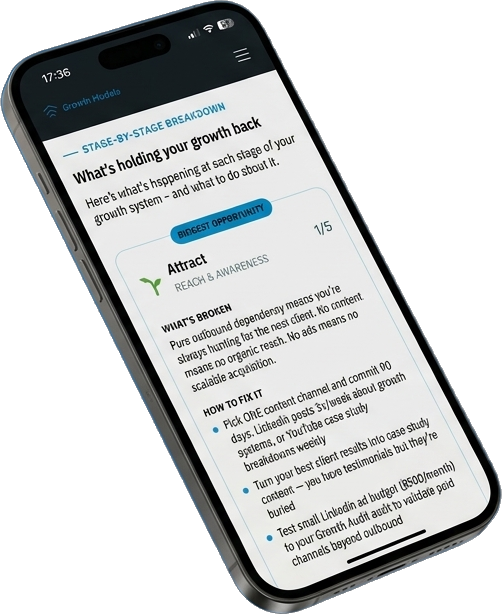
Not sure where your current system is leaking? Take the free growth diagnostic. It maps your business against all five ACCER stages and shows you exactly where to focus first.