Stop Chasing Leads. Start Attracting Buyers.
“I have 50,000 people on my email list but nobody is buying.”
I hear this constantly. Founders, course creators, coaches. They have spent months or years building an audience. The numbers look impressive. And revenue is flat.
The problem is not the size of the list. The problem is who is on it.
Two Types of People in Every Audience
No matter what industry you are in, no matter what you sell, your audience contains two groups:
Get a free five-step strategy to grow your business more profitably
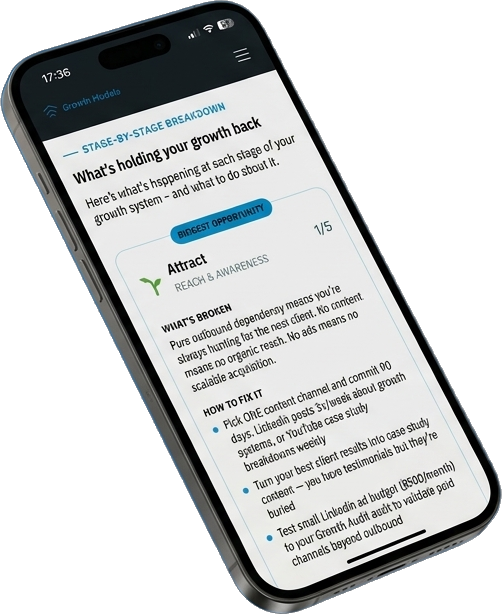
Answer a few questions about how you get and keep customers, and get a detailed report on the handful of actions that'll grow your business more profitably. Free, about five minutes.
Takers. Freebie seekers. They signed up because you offered something for free. A PDF, a checklist, a webinar, a template. They took it. And what they want next is more free stuff. More templates. More resources. More of your time and energy for nothing in return.
Givers. Paying customers. People who saw a problem, valued the solution, and paid for it. They have skin in the game. They implement what they learn. They ask better questions. And when you offer them the next thing, they buy that too.
Here is the uncomfortable truth. When you build your audience with free lead magnets, you attract a list that is 99% takers. The few genuine buyers get buried in a sea of people who will never spend a penny with you.
You end up with vanity metrics. Big numbers on your email list. Decent open rates, maybe. But when you launch an offer? Crickets.
The takers are not going to convert. Not now. Not with a 10-email nurture sequence. Not with a webinar. They signed up for free, and free is what they expect from you going forward.
The Organic Trap
Most people try to solve this with organic content. Blog posts, social media, YouTube, LinkedIn. And organic can work. It does work for some people.
But it is hard. Much harder than most people admit.
The competition is enormous. If you are building on Google, you are competing with companies that have hundreds or thousands of people producing content. If you are on LinkedIn, you are going up against engagement pods and people who have spent years gaming the algorithm. If you are on social media, you are at the mercy of whatever the platform decides to show today.
And even when organic works, it creates a specific problem. Social platforms reward content that gets engagement. Likes, comments, shares. That kind of content tends to be broad, entertaining, and free. It attracts an audience of consumers, not buyers.
The algorithm wants eyeballs. You want customers. Those are not the same thing.
Then there is the consistency problem. You share a post today and it reaches 100,000 people. You share the same quality post next week and it reaches 200. The algorithm shifted. Your reach vanished. And you have no control over it.
Organic locks you onto a hamster wheel. You have to keep producing content to keep the algorithm warm. Stop posting and your visibility drops off a cliff. It is not a system. It is a treadmill.
The biggest issue? Organic is built for freebie seekers. To game the algorithms, you often have to create content designed for mass appeal rather than targeted relevance. Mass appeal brings takers. Specificity brings buyers. The algorithms penalise specificity because niche content does not generate the engagement numbers they want.
Why Paid Changes the Game
Paid advertising solves most of these problems. Not all of them. But most.
Speed. You can launch an ad and put it in front of a thousand people today. Not next month. Not in six months when the SEO compounds. Today.
Targeting. You choose who sees your offer. Not an algorithm. You. Direct access to the exact audience you want to reach.
Consistency. Paid traffic is predictable. There are seasonal fluctuations, sure. But once you find an ad that works, it keeps working. You are not at the mercy of algorithmic mood swings.
Feedback. You get data fast. Put $50 behind an ad, reach a thousand people, and you know within days whether your offer resonates. Compare that to publishing a blog post and waiting three months to see if it ranks.
But here is the real difference. Paid, done right, does not just build a list of leads. It builds a list of buyers. And that changes everything.
The Economics That Make It Work
Two numbers matter when running paid acquisition.
CPA (Cost Per Acquisition) needs to be lower than AOV (Average Order Value).
That is the whole game. You need to spend less to get a customer than that customer pays you.
My own numbers right now: $35 CPA, $65 AOV. That is $30 profit per customer on the front end. Before any backend offers. Before any upsells. Before any high-ticket sales.
Every single customer who comes through the door pays for themselves and then some. The acquisition cost is covered within 24 hours.
You might think $30 profit per customer does not sound like much. You are right. On its own, it is not life-changing. But that is not the point. The point is that your customer acquisition is now self-funding. And the real money is made on what comes next.
The Payback Period
Here is a concept most people ignore, and it kills businesses.
Every lead generation system has a cost. Even organic. Your time is worth something. If you charge $250 an hour and spend three hours creating content, that content cost you $750.
Once you spend that money (or time), the clock starts. You are in the red. As customers come in and pay you, you climb back toward break-even. Once you hit break-even, everything from that point on is profit.
The time between spending and breaking even is your payback period. And it needs to be as short as possible.
There is a lot of advice online that says “you need to spend $10,000 a month on ads or you are not serious.” Fine. But if it takes six months to recoup that spend, you need $60,000 in cash reserves before you see a return. Can you afford that? Most businesses cannot.
This is why I focus on average order value over lifetime value in the early stages. Lifetime value is important, but it plays out over months. You need money back now. Today. This week.
When your CPA is lower than your AOV, you can get paid back within 24 hours. That means you can reinvest immediately. Scale faster. Reach more people. Bring in more buyers. The whole thing compounds.
Why VSSL-to-Call Funnels Are Expensive
There is a popular model that goes: ads to opt-in to video sales letter to book a call. The salesperson then closes the deal on the phone.
It works. Especially for high-ticket offers at $3,000 and above.
But the economics are brutal.
You are looking at $100 to $500 per call booked, depending on your industry. If your close rate is 25% (one in four), your real CPA is $400 to $2,000. If your offer is only $2,000, you have barely broken even after the sale. And that is before you factor in the cost of the setters and closers you need to handle the calls at scale.
There are also a lot of moving parts. The ads need to work. The opt-in needs to convert. The VSSL needs to sell. The caller needs to close. If any single element underperforms, the whole thing bleeds money.
And the leads? A huge chunk of them are freebie seekers. They wanted the free webinar or the free training. They booked a call because it seemed like the next step. Then they either do not show up or turn out to be completely unqualified.
You spend a lot of money and time filtering through people who were never going to buy.
The Low-Ticket ACCER Approach
Here is the model I use, and the one that has helped members of the Growth Models community see up to 12x more sales of their signature offers.
It is built on the ACCER framework. One solid approach at each stage: Attract, Capture, Convert, Engage, Refer.
The key difference from other models: we skip the free lead magnet. Instead, we go straight from ads to a low-ticket offer. Something in the $7 to $47 range. Low enough that buying is a no-brainer. High enough that it filters out the freebie seekers.
The flow:
Ads (Attract) –> Sales page with low-ticket offer (Convert) –> Upsells at checkout –> Email nurture (Engage) –> Higher-ticket offers –> Referrals (Refer)
Notice what is missing. No free opt-in. No months of nurturing cold leads. No hoping that someone who downloaded a PDF three months ago will eventually buy something.
Instead, you start with a buyer. Someone who has already proven they value your expertise enough to pay for it. That is a fundamentally different relationship than someone who grabbed a free checklist.
When your CPA is lower than your AOV, this system funds itself. My ad spend comes back within 24 hours. I put it on a charge card and the revenue hits before the statement is due. The acquisition cost is covered on the front end, which means every sale on the backend is 100% profit.
Compare that to the VSSL-to-call model where you are eating into your high-ticket profit margins just to cover the cost of getting people on the phone.
Buyers Buy Again
This is the compounding effect that makes the whole system work.
Someone who pays you $27 has shown you they will spend money on solutions. When you then offer them something at $197, or $1,000, or $5,000, you are selling to a proven buyer. Not a stranger. Not a freebie seeker. Someone with skin in the game.
People who have used this system report up to 12x more sales of their signature offers. Not because the offers changed. Because the audience changed. They stopped selling to takers and started selling to givers.
A list of 500 buyers is worth more than a list of 50,000 leads. Dramatically more. Because those 500 people will buy from you again and again if you continue to deliver value.
This is what profitable lead generation actually looks like. Not a big list. A valuable one.
The Backend Is Where the Money Lives
Once your front end is self-liquidating, the economics of your business flip completely.
Your customer acquisition costs are covered. Every buyer who comes through the front door has already paid for themselves. So when they buy your $500 programme, your $2,000 consulting package, or your $5,000 done-for-you service, that revenue is pure profit.
You are not subtracting ad costs from those sales. You are not factoring in the cost of content production or sales team overhead. The front end handled all of that.
This is how you build a genuinely predictable growth system. Not by hoping organic reaches the right people. Not by spending thousands to book calls with unqualified leads. By building a front end that funds itself and feeds a backend that prints money.
How to Start
If you have been building a list of freebie seekers and wondering why nobody buys, the fix is not another nurture sequence. It is not a better email subject line. It is not posting more on LinkedIn.
The fix is changing who you attract in the first place.
Define your ideal customer. Build a low-ticket offer that solves their most immediate problem. Run ads to it. Get the economics right so your CPA is below your AOV. Then use email to ascend those buyers into your higher-ticket offers.
Stop chasing leads. Start attracting buyers. The revenue follows.
Not sure where your current system is breaking down? Take the free growth diagnostic. It maps your business against all five ACCER stages and shows you exactly where to focus first.