The Rule of One: Why the Most Profitable Businesses Focus on Less, Not More
Most businesses don’t fail because they’re doing too little. They fail because they’re doing too much.
LinkedIn posts on Monday. Facebook ads on Tuesday. A YouTube video on Wednesday. Cold DMs on Thursday. A newsletter that goes out when someone remembers. And by Friday, nothing’s actually working. Nothing’s had enough focus to get good.
Bruce Lee said it better than anyone: “I fear not the man who has practised 10,000 kicks once, but the man who has practised one kick 10,000 times.”
That’s the Rule of One. And it’s the single biggest lever most $1M–10M businesses aren’t pulling.
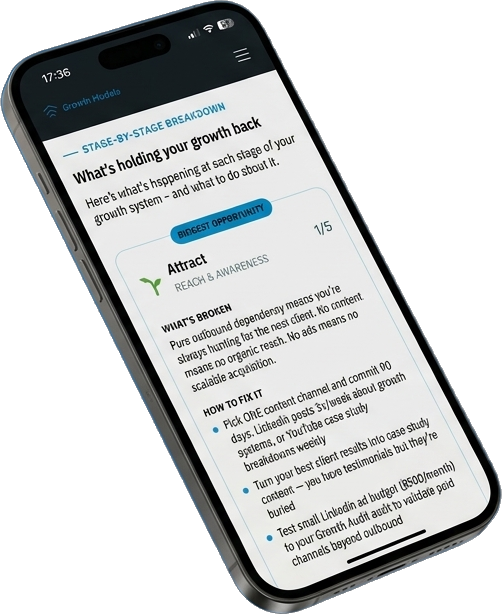
Get a free five-step strategy to grow your business more profitably
Answer a few questions about how you get and keep customers, and get a detailed report on the handful of actions that'll grow your business more profitably. Free, about five minutes.
What the Rule of One Actually Means
It doesn’t mean you literally do one thing. It means you focus on one thing at each stage of your growth system:
- One offer (delivered at multiple price points)
- One primary channel to attract buyers
- One system that ties it all together
That’s it. No spreading across six platforms. No running three different funnels for three different audiences. No patchwork of disconnected tactics held together with hope and a Trello board.
One model. Focused. Compounding.
One Offer, Three Tiers
Most people think one offer means one product. It doesn’t.
It means one core transformation, packaged at three levels:
- Do it yourself: a course, a system, a resource. Take it and go.
- Done with you: coaching, advisory, check-ins. Same transformation with guidance.
- Done for you: full execution. You don’t lift a finger.
The key? It’s the same offer. The same core promise. The same marketing. You’re not building three businesses. You’re building one with three entry points.
Take nutrition as an example. DIY might be a meal planning course. Done-with-you is weekly check-ins with a nutritionist. Done-for-you is a fully prepared meal plan delivered to your door. Same problem. Same solution. Three price points.
This matters because customers self-select. The person who buys the $47 course today might become the $5,000 done-for-you client in six months. You’ve built a natural ascension path without needing a separate funnel for each tier.
The $2.4 Million Solopreneur
I consulted with a founder running a course business. Essentially a one-person operation with a VA. He sold a $2,000 course with a $700 cost per acquisition. That’s $1,300 profit per customer.
Revenue: $2.4 million per year.
His entire system was three things:
- Facebook ads driving traffic to a video sales letter
- A nurture email sequence on the backend
- The course itself
That’s it. No LinkedIn strategy. No podcast. No organic social content calendar. When something needed improving, he knew exactly where to look. Click-through rates low? Fix the ads. VSSL not converting? Test the hook. Email open rates dropping? Rewrite the subject lines.
Every optimisation compounded on the last one. Every improvement made the whole system more profitable. He wasn’t juggling seven channels. He was getting surgically better at one.
Why This Works: The ACCER Model
“But how do I focus on one thing when there are so many moving parts?”
Fair question. You need a model, not just a mantra.
The ACCER framework gives you five stages: Attract, Capture, Convert, Engage, Refer. The Rule of One means you pick one tactic at each stage and build them into one coherent system.
Here’s what that looks like:
| ACCER Stage | Your One Thing |
|---|---|
| Attract | Facebook ads (your primary traffic channel) |
| Capture | A VSSL or lead page that collects email addresses |
| Convert | A low-ticket offer (the front door to your business) |
| Engage | A daily email sequence that nurtures and ascends |
| Refer | An affiliate programme that turns customers into promoters |
Five stages. Five tactics. One system.
When something breaks (and something always breaks), you know exactly where to look. You’re not debugging seven channels and three funnels. You’re fixing one stage.
That’s what separates growth marketing from tactics. Tactics are individual plays. A model is how they fit together.
The Yes Ladder: Low Ticket to High Ticket
Most businesses try to sell high-ticket offers to cold traffic. Ads straight to a $5,000 programme. It’s too big a jump. Most people aren’t ready.
The Rule of One solves this with what I call a yes ladder.
Start with a low-ticket offer. Something small enough that saying yes is easy. $7, $27, $47. The goal isn’t profit at this stage. The goal is to generate buyers, not leads.
Once someone buys, trust increases. They’ve consumed your thinking. They’ve seen results, even small ones. Now you’ve earned the right to make a bigger ask.
The sequence looks like this:
Low-ticket offer → Email nurture → Mid-ticket upsell → High-ticket programme
Each step builds on the last. Each yes makes the next yes easier. And the whole thing runs inside your ACCER model. Convert handles the front end, Engage handles the ascension.
This is why a self-liquidating offer isn’t a business on its own. It’s the entry point to a business. The profit lives in Engage and Refer. The front end just funds the customer acquisition.
How to Find Your “One”
If you’re already doing five different things, the Rule of One can feel like you’re leaving money on the table. You’re not.
Apply the 80/20 rule. Where is 80% of your results coming from? That’s probably 20% of your activity. Do more of that. Cut the rest.
If Facebook ads are bringing in 80% of your revenue and LinkedIn is bringing in 3%, stop pretending LinkedIn is about to turn a corner. It’s not. Put that energy into making your ads, and the system behind them, twice as good.
The question isn’t “what else should I be doing?” It’s “what should I stop doing so the thing that works can compound?”
Once your one system is scaled, automated, and profitable, then you can layer on a second channel. But not before. Get one kick to 10,000 repetitions before you learn the next one.
The Real Advantage: Compounding Focus
Here’s what most people miss about the Rule of One. It’s not just about efficiency. It’s about compounding.
When you focus on one system, every improvement builds on the last one. Better ads lead to cheaper traffic. Cheaper traffic means more customers in your email sequence. More customers mean more data on what converts. Better conversion data means better offers.
It’s a flywheel. And it only spins when you stop splitting your energy across six different things that each get 15% of your attention.
Scattered effort produces scattered results. Focused effort compounds.
Start Here
If your growth feels stuck, or if you’re busy but not actually growing, the fix probably isn’t another channel. It’s focusing the channels you have into one system that compounds.
Not sure where your system is leaking? Take the free growth diagnostic – it maps your business against all five ACCER stages and shows you exactly where to focus first.