The Value Ladder Strategy: How a $1 Product Can 12x Your High-Ticket Sales
Most businesses try to sell high-ticket offers to cold audiences. Ads to a free lead magnet. A nurture sequence. Then a high-pressure sales call where you try to close someone who barely knows you.
It works. Sort of. But it is inefficient, expensive, and brutally hard to scale.
There is a better way. The value ladder strategy puts a low-ticket product between your free content and your premium offer. Even something as low as $1. That single step filters out freebie seekers, builds real trust through consumption, and creates a natural path to your high-ticket sale.
The result? Buyers of a low-ticket product are up to 12 times more likely to purchase a higher-ticket offer compared to free leads. Not a small improvement. A fundamental shift in how your business acquires and ascends customers.
Get a free five-step strategy to grow your business more profitably
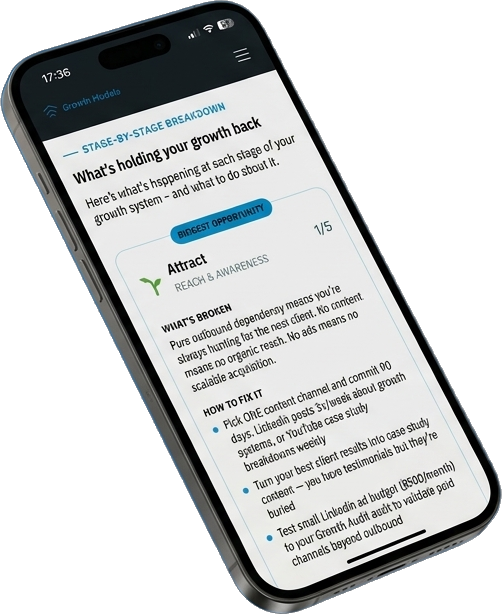
Answer a few questions about how you get and keep customers, and get a detailed report on the handful of actions that'll grow your business more profitably. Free, about five minutes.
What Is a Value Ladder Strategy?
A value ladder strategy is a system that moves customers through progressively higher-priced offers, building trust and delivering results at each step before asking for a bigger commitment.
Instead of jumping from “here is a free PDF” to “pay me $5,000,” you create stepping stones. Each one delivers value, earns trust, and makes the next yes feel like the obvious next move.
Think of it as a series of small commitments that compound. Every time someone pays you and gets a result, the barrier to the next purchase drops. Not because you pressured them. Because they experienced the transformation firsthand.
Why Free Lead Magnets Kill Your High-Ticket Sales
The standard approach looks like this. Run ads. Offer a free lead magnet or video training. Capture the email. Push people towards a sales call. Close on the call.
The problem? Free stuff does not get consumed.
Think about the last free template, guide, or training you downloaded. Did you use it? Do you even remember who gave it to you? Most people don’t. There is no skin in the game. No reason to prioritise it. It sits in a downloads folder gathering digital dust.
When people do not consume your content, they do not build trust with you. Which means your sales call has to do all the heavy lifting. You are trying to take someone from zero awareness to a $2,000 commitment in 45 minutes. That is a massive jump.
The consequences are predictable:
- Low show rates. Only 30-40% of people who book calls actually turn up.
- High pressure required. The call has to build trust AND close. That is a lot of work for one conversation.
- Expensive to scale. You need setters to book the calls and closers to run them. Your $2,000 sale suddenly costs $700-$1,000 in acquisition.
- Thin margins. If you are making $1,000 profit per sale after ad spend and team costs, there is not much room to grow.
The core issue is what I call the yes ladder. Every purchase has a threat level. High-ticket offers sit at the top. Free lead magnets sit at the bottom. When you jump straight from free to high-ticket, the gap is too wide. Most people will not make that leap, no matter how good your sales call is.
How the Value Ladder Strategy Fixes This
The fix is simple in concept. Add a step between free and high-ticket. A low-ticket offer that costs real money, even if it is only $1.
Here is what the system looks like:
- Attract. Drive traffic through ads, content, or organic channels.
- Convert (low-ticket). Send people to a low-cost offer. $1, $7, $27, $47. Small enough that saying yes is easy.
- Ascend (engagement). Deliver value. Build trust through a structured sequence that removes hesitations.
- High-ticket offer. Present your premium product to people who already know, trust, and have experienced results from your work.
This maps directly to the ACCER framework. Attract brings people in. Convert handles the front end. Engage builds the relationship. And the high-ticket sale becomes a natural outcome rather than a forced close.
The magic is in what happens when someone pays. Even $1 changes the dynamic completely.
Why a $1 Product Changes Everything
A dollar is nothing. But the act of paying transforms behaviour in three critical ways.
1. It filters serious people from freebie seekers
Everyone will take something free. Not everyone will spend a dollar. That tiny barrier separates the people who are genuinely looking for a solution from the people who collect free resources and never act on them.
You end up with fewer leads but dramatically better ones. The kind who actually engage, consume, and buy again.
2. It drives consumption
When people pay for something, they use it. Even if it is only a dollar, there is a psychological shift. “I paid for this. I should get my value out of it.” That consumption is where trust gets built. They experience your thinking, your systems, your approach. They see results, even small ones.
3. It creates a natural yes ladder
The first purchase, no matter how small, is always the hardest. Once someone has bought from you, the second purchase is easier. The third easier still. Each yes makes the next yes more natural.
You are not trying to leap from free to $5,000. You are climbing a staircase. $1 to $47 to $297 to $2,000. Each step feels manageable because the previous one delivered value.
How to Build a Value Ladder That Compounds
Here is how to structure your value ladder from front to back.
Step 1: Create a low-ticket entry point
Your low-ticket offer should solve a specific, contained problem. Not your entire methodology. A single piece that delivers a quick result and demonstrates your approach.
Price it low enough that the decision is almost automatic. $1 to $47 is the sweet spot. The goal is not profit at this stage. The goal is to acquire a buyer, not a lead. There is a massive difference between the two. Generating buyers rather than leads changes every metric downstream.
Step 2: Make the front end self-liquidating
Structure your low-ticket offer with order bumps and immediate upsells so the front end pays for itself. This is a self-liquidating offer. You put a dollar into ads, you get a dollar back (or more) from the initial purchase.
In practice, this might look like a $1 core product with a $27 bump and a $47 upsell. Your average order value might land at $30-65 depending on take rates. If your cost per acquisition is $30, you are acquiring customers for free. Or even at a profit.
That means every high-ticket sale on the back end is pure profit. Compare that to spending $700-$1,000 per high-ticket acquisition with the traditional model.
Step 3: Build an ascension sequence that earns the right to sell
Between the low-ticket purchase and the high-ticket pitch, you need a structured engagement system. This is the Engage stage of ACCER, and it is where most businesses either win or stall.
Your ascension sequence should:
- Help people implement what they bought (driving consumption)
- Share results and case studies (building proof)
- Address specific hesitations about the next tier (removing friction)
- Position the high-ticket offer as the logical next step (not a hard sell)
This does not need to be complicated. A well-structured email sequence can do most of the work. The key is that you are building trust through delivered value, not through pressure.
Step 4: Present the high-ticket offer to warm buyers
When someone has paid you, consumed your content, seen results, and been guided through a trust-building sequence, the high-ticket sale is a different conversation entirely.
You do not need high-pressure tactics. You do not need a 45-minute call that is really a disguised pitch. You can use a simple sales page, an application form, or a short consultative call. The trust has already been built.
Sales mechanisms that work well at this stage:
- Long-form sales pages (the trust is already there, so copy can close)
- Application forms that filter for fit (serious buyers only)
- Short consultative calls (not closers, actual conversations)
- Even Google Doc proposals for high-end services
The Numbers: Why This Outperforms the Traditional Model
Let us compare the two approaches side by side.
| Metric | Traditional (Free Lead Magnet) | Value Ladder ($1 Product) |
|---|---|---|
| Cost per lead/customer | $5-20 per lead | $30 per buyer (self-liquidated) |
| Consumption rate | Low (free = ignored) | High (paid = used) |
| Trust at point of sale | Minimal (call must build it) | High (built through consumption) |
| High-ticket conversion rate | 1-3% of leads | Up to 12x higher than free leads |
| Profit per high-ticket sale | $1,000 (after $700-1,000 acquisition) | $2,000 (front end self-liquidated) |
| Scalability | Requires setters + closers | System-driven, fewer calls needed |
The value ladder does not just improve one metric. It improves every metric. Better leads, higher consumption, more trust, higher conversion, better margins, easier to scale.
Real Example: $469 in 10 Days From a Cold Market
I launched a $1 product in an industry where I had no reputation. No audience. No existing trust. Within 10 days, 25 customers came through. Total revenue was $469 from the front end alone (thanks to bumps and upsells lifting the average order value).
But here is the important part. Within those 10 days, one of those $1 buyers hired me for a consulting engagement. Not because I pitched them on a call. Because they consumed the $1 product, saw how I think, and decided they wanted more.
That is the value ladder in action. The $1 product is not the business. It is the front door to the business. The profitable offer lives further up the ladder. The low-ticket product just ensures the right people walk through the door.
Common Mistakes When Building a Value Ladder
The concept is straightforward. The execution trips people up in a few predictable ways.
Mistake 1: Making the low-ticket offer too comprehensive. Your $1 product should not be your entire system repackaged cheaply. It should solve one specific problem well. If it does everything, there is no reason to ascend.
Mistake 2: Skipping the ascension sequence. You still need to nurture buyers after the initial purchase. The low-ticket offer builds trust, but you need a system to channel that trust towards the next step. Do not just drop people onto a sales page a week later.
Mistake 3: Treating the front end as a profit centre. The purpose of the low-ticket offer is to acquire buyers and self-liquidate your ad spend. If you are trying to make money at this stage, you will under-invest in what actually matters: the back end.
Mistake 4: Ignoring the overall growth system. A value ladder is not a standalone tactic. It needs to fit into a coherent system. Attract, Capture, Convert, Engage, Refer. If one stage is broken, the ladder collapses.
Frequently Asked Questions
What is the difference between a value ladder and a sales funnel?
A sales funnel is the sequence of pages and steps someone moves through to make a purchase. A value ladder is the pricing and product strategy that moves customers from low-commitment to high-commitment offers over time. The funnel is the mechanism. The value ladder is the strategy that determines what you sell at each stage and why.
How do you price a low-ticket offer in a value ladder?
Price your low-ticket offer between $1 and $47. The goal is not profit. It is filtering serious buyers from freebie seekers and funding your customer acquisition through a self-liquidating model. Add order bumps and upsells to bring your average order value above your cost per acquisition.
Can a value ladder strategy work for service businesses?
Yes. Service businesses can use a low-ticket diagnostic, audit, or template as the entry point. The key is that the low-ticket product demonstrates your thinking and delivers a quick result, which builds trust for the higher-ticket service engagement. The same principle applies: paid consumption builds more trust than free content.
How long should the ascension sequence be between low-ticket and high-ticket?
There is no fixed timeline. Focus on consumption and trust rather than days. Some buyers will ascend in 48 hours. Others take weeks. Your sequence should help people implement what they bought, share proof that your approach works, and naturally position the next tier as the logical step. Most effective sequences run 7-21 days of structured content.
Why are paid leads better than free leads for high-ticket sales?
Paid leads have demonstrated two things free leads have not. Willingness to spend money on solving their problem, and enough trust in you to hand over their payment details. That combination means higher engagement, higher content consumption, and up to 12x higher conversion rates on back-end offers. A smaller list of buyers will always outperform a large list of freebie seekers.
Not sure where your system is leaking? Take the free growth diagnostic. It maps your business against all five ACCER stages and shows you exactly where to focus first.