The Five-Stage Growth System Behind Every Successful Brand
Every successful growth strategy I’ve ever run breaks down into five stages. Every strategy I’ve ever analysed does too.
Doesn’t matter if it’s B2C, B2B, SaaS, physical products, info products, services, or coaching. The model is the same. The tactics change. The structure doesn’t.
It’s called the ACCER model: Attract, Capture, Convert, Engage, Refer. And if you want to sell anything online, this is the system you need.
I’ve written a detailed breakdown of the ACCER framework that goes deep on the theory. This article is the practical companion. One asset per stage. How to pick them. How they fit together. How to actually build this thing.
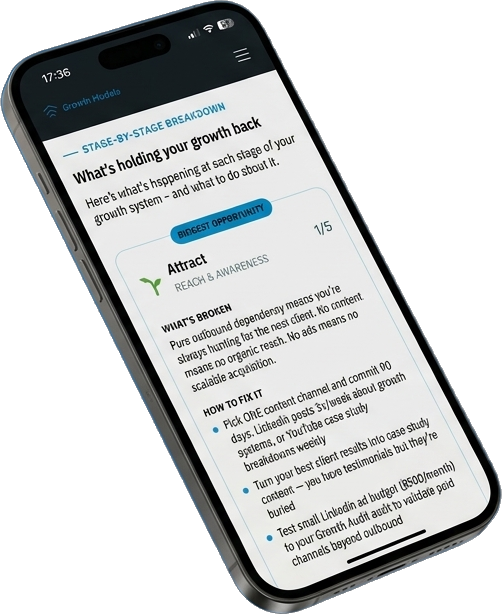
Get a free five-step strategy to grow your business more profitably
Answer a few questions about how you get and keep customers, and get a detailed report on the handful of actions that'll grow your business more profitably. Free, about five minutes.
Before You Build: You Need a Product
This sounds obvious. It isn’t.
Too many people obsess over SEO, killer ad copy, conversion rate optimisation, and email sequences before they have something worth selling. All of those things are useless without a product that solves a real problem.
If your product is weak, no amount of marketing will save it. The best growth system in the world can’t fix a bad offer.
Get the product right first. Then build the system to sell it.
Stage One: Attract
Attract is how you get your offer in front of the right people. That’s it. Nothing more complicated than that.
The options are endless. SEO. Facebook ads. Direct outreach. YouTube. Organic social. In-person events. LinkedIn. Podcasts. Each one works. You can find seven-figure businesses built on any single one of these channels.
The problem is survivorship bias. Every person selling a channel as a service will tell you theirs is the best. The SEO consultant says SEO is king. The Facebook ads manager says paid social is the only way. The cold outreach agency says everything else is a waste.
They’re all wrong. And they’re all right.
Here’s what actually matters: which channel can you be consistent with?
Attract is the one stage that never stops requiring daily action. You need to keep publishing, keep running ads, keep sending outreach. Whatever your channel is, it needs constant fuel.
So pick the one you can sustain. The one where you’ll show up day after day, improve your craft, and get incrementally better. Consistency compounds. If you can be consistent with YouTube, do YouTube. If you can be consistent with paid ads, do paid ads. If you can write and your messaging is dialled in, maybe SEO and content is your play.
Don’t pick the “best” channel. Pick yours. Then get very good at it.
Stage Two: Capture
Capture is where you collect contact details so you can continue the relationship. Email address, phone number, whatever allows you to nurture someone toward a purchase.
The key: low threat. You’re not asking for a big commitment. You’re asking for permission to keep talking.
Common capture methods:
- Lead magnets. Free resources in exchange for an email address.
- Content upgrades. Bonus content related to what they’re already reading.
- Book a call. Works well with direct outreach. “I help people like you do X. Want 15 minutes to see if it fits?”
- Low-ticket front-end offer. A $7 product that pays for the lead. They give you money and their email. You get a buyer, not just a subscriber.
- Entry-level course. Something small enough that saying yes is easy.
Which capture method you use depends on your Attract channel. They have to match.
If you’re driving traffic through SEO and blog content, content upgrades are brilliant. If you’re running Facebook ads, a self-liquidating offer that recovers your ad spend is the smart play. If you’re doing direct outreach, “book a call” is natural.
Attract and Capture work as a pair. Build them together, not in isolation.
Stage Three: Convert
This is where money changes hands.
Sales pages. Video sales letters. Phone calls. Product pages. Checkout flows. Whatever mechanism turns a prospect into a paying customer.
Now, here’s the nuance. Not every path goes Attract > Capture > Convert in a straight line.
If you have a big social following and a $10 product, people will buy directly. No capture step needed. You go straight from Attract to Convert.
But for anything over $200-$500, you’ll need a nurture phase between Capture and Convert. People don’t impulse-buy a $2,000 programme. They need time, trust, and evidence that you can deliver what you promise.
That nurture happens through email sequences, follow-up calls, content that demonstrates your expertise. Each touchpoint reduces risk and builds confidence. Each touchpoint pushes them closer to the purchase.
The emails in that nurture sequence should specifically sell the offer. Not “newsletter” content. Not “value” for the sake of value. Content that addresses the reasons people aren’t buying yet. What results have others got? What does implementation look like? Why is this worth the investment?
If you want to see how that plays out in practice, the hesitation-removal approach to email sequences is the most effective method I’ve found for converting nurtured leads into buyers.
Stage Four: Engage
Most people stop at Convert. Get the sale. Move on. Find the next customer.
This is where the money leaks.
Here’s a simple example. You have a $100/month product. You add 10 new customers per month. At face value, that’s $1,000 additional MRR every month. $12,000 MRR by the end of the year.
But if you’re losing 5 customers per month to churn, you’ve halved everything. Your end-of-year MRR is $6,000. If your operating costs are above that, you’re losing money despite adding customers every single month.
Churn is the silent killer. And Engage is how you fight it.
The job of the Engage stage is simple: help customers get maximum value from what they bought. If they see results, they stay. If they stay, they buy again.
How you do this depends on your offer:
- Software: Email sequences highlighting key features. “Have you tried this? Here’s how it saves you three hours a week.”
- Courses: Accountability sequences. “You haven’t finished Module 3. Here’s why it matters.”
- Community: Daily engagement. Being present. Adding value.
- Single-product business: Find the next offer. Continue selling through email sequences that ascend customers to higher-value products.
The goal isn’t just retention. It’s deepening trust. Every positive experience builds the case for the next purchase. A customer who’s seen real results from your $47 product is primed for your $500 offer. And the customer who succeeds with your $500 offer becomes the obvious candidate for your $5,000 programme.
Engage is where lifetime value lives. And lifetime value is where profit compounds.
Stage Five: Refer
Happy customers become your most powerful marketing channel.
Refer closes the loop. It connects back to Attract, creating a flywheel where each customer potentially brings in another.
Methods that work:
- Affiliate programmes. Pay customers to refer friends. If your customer lifetime value is $100, paying $20 per referral gives you an 80% profit margin on each new customer. Zero ad spend.
- User-generated content. Testimonial videos, reviews, case studies. Share them on your social channels to boost your Attract efforts.
- Simple referral incentives. “Refer a friend, get a month free.” Low cost to you, high perceived value to them.
The beautiful thing about Refer: it feeds the whole system. A testimonial video shared on social media attracts new prospects. Those prospects enter your Capture and Convert stages. The best of them become engaged customers who create their own testimonials. The flywheel spins.
This is what separates a business from a growth system. A business acquires customers. A system acquires customers who acquire more customers.
One Asset Per Stage
If you’re early stage, or if your resources are limited (and whose aren’t?), here’s the rule: one asset per stage.
Don’t try to do SEO and Facebook ads and organic social and YouTube. Pick one Attract channel. Pick one Capture method. Pick one Convert mechanism. One Engage system. One Refer strategy.
Five stages. Five assets. One system.
| ACCER Stage | Pick One |
|---|---|
| Attract | The channel you can be most consistent with |
| Capture | The method that matches your Attract channel |
| Convert | The sales mechanism that fits your price point |
| Engage | The system that keeps customers active and ascending |
| Refer | The incentive that turns customers into promoters |
Then persist.
People start SEO and quit after three weeks because they haven’t generated 20,000 visitors. People start running ads and quit after a week because they haven’t hit profitability.
Growth compounds. But it needs time. Pick your one thing at each stage, get good at it, and let the system build momentum.
When it’s working and you can clearly see what’s producing results, then consider adding a second asset to a stage. Not before. The Rule of One applies here: focus beats fragmentation every time.
The System Compounds
Each stage feeds the next. Attract sends people to Capture. Capture nurtures them to Convert. Convert creates customers for Engage. Engage builds trust for higher-value offers. Refer creates a flywheel back to Attract.
Improve any single stage and the whole system gets better. Fix your Attract channel and more people enter Capture. Improve your Convert rate and more people become customers for Engage. Strengthen your Engage sequence and more customers become referral partners.
It’s one system. Not five separate tactics. That’s the difference.
Not sure which stage needs the most attention in your business? Take the free growth diagnostic. It maps your business against all five ACCER stages and tells you exactly where to focus first.