Self-Liquidating Offers: Why Your SLO Isn’t a Business
If you’re treating your self-liquidating offer as your primary income stream, you’re leaving an absurd amount of money on the table.
People share social proof about their SLOs all the time. “$231 a day in revenue.” “$2,259 in a week.” Sounds impressive. Until you look at the actual numbers.
That $231 a day? After $70 a day in ad spend, you’re at $160. After operational costs, you’re looking at maybe $100 in actual profit. That’s $3,000 a month. Before tax.
It’s not nothing. But it’s not a business. It’s a front door. And most people never build the house behind it.
Get a free five-step strategy to grow your business more profitably
Answer a few questions about how you get and keep customers, and get a detailed report on the handful of actions that'll grow your business more profitably. Free, about five minutes.
The Misunderstanding That Costs You Everything
The fundamental mistake is treating the SLO as the end of the journey. Building a $1 product or a low-ticket offer, optimising the average order value, getting the front-end economics to work, and then stopping. As if $30 profit per customer is the whole game.
It’s not. Not even close.
A self-liquidating offer has one purpose. One. To identify buyers at cost, or a small profit.
That’s the only thing it’s trying to do. It’s not going to be its own revenue stream that buys you a house. The economics don’t work that way at any reasonable scale.
Consider this. If your SLO generates $30 profit per customer and you acquire 100 customers a day (which is ambitious), that’s $3,000 a day in profit. Sounds good. But that’s before operating costs, before tax, before the reality that not every day performs the same. And you’re depending entirely on a single-purchase model with no recurring element and no backend.
The SLO is the start. The real business lives behind it.
Two Journeys, Not One
When I used to build marketing departments for software companies, I’d explain it as two separate journeys.
The purchase journey. This is how someone goes from stranger to customer. Your marketing activities drive traffic. The $1 product or low-ticket offer converts them. Bump offers and upsells increase the average order value so you can reinvest in acquisition. This creates a customer.
That’s journey one. Important. Necessary. But incomplete on its own.
The customer journey. This is how a customer becomes a client. A repeat buyer. Someone who pays you $300, then $3,000, then $30,000. This is where you increase the value you provide, which increases the trust they have in you, which allows you to increase their lifetime value.
Most people only build journey one. They get really good at acquiring customers at $30 profit each. And then they wonder why they can’t scale past a certain point.
The answer is that they never built journey two. They never built the ascension system that turns one-time buyers into long-term clients.
The Maths That Changes Everything
Jay Abraham’s three rules for growing a business: increase the number of customers, increase how much they pay you (average order value), and increase how often they pay you (lifetime value).
Your SLO handles the first one. It brings in customers at a price you can sustain. Good. But if all you ever extract is $30 per customer, you need an insane volume to build a real business. And you’ll hit a ceiling, because only 1-3% of your total addressable market is ready to buy at any given time.
Now imagine a different scenario. Some customers stay at $30. Some ascend to $300. Some make it all the way to $3,000. Your average lifetime value across all customers jumps to $500.
Growing a business where each customer is worth $500 on average is a fundamentally different challenge from growing one where each customer is worth $30. Every part of the equation becomes easier. Your ad spend can be more aggressive because the payback is higher. Your profit margins expand. Your business becomes genuinely scalable.
The Yes Ladder: From $1 to High Ticket
Here’s the mechanism that makes it work. I call it the yes ladder.
Most businesses try to sell high-ticket offers to cold traffic. Ads straight to a $2,000 per month programme. It’s too big a jump. Too much trust required from someone who doesn’t know you yet.
When you say to a stranger “we’ve just met, pay me $2,000 a month for a year,” the answer is almost always no. But when you say “I’ve got this thing, it might help, it’s a dollar,” the answer is almost always “sure, I’ll take the chance.”
That first yes is everything. Because once someone has paid you, even a dollar, the dynamic changes completely.
The SLO gets the first yes. The bump offers and upsells get a slightly bigger yes. Then, after they’ve received value and built some trust, you present a mid-ticket offer. Then, when the time is right, you present the high-ticket programme.
$1 > $47 > $99 > $2,000+
Each step is a small, logical escalation from the last. Each yes builds on the previous one. Each purchase increases trust and lowers resistance to the next ask.
This is why buyers are 12 to 56 times more likely to purchase a high-ticket offer compared to free leads. They’ve already self-selected. They’ve already demonstrated willingness to spend. You’ve already filtered out the freebie seekers who were never going to buy anyway.
The SLO as a Buyer Filter
This is the reframe that changes how you think about your entire front end.
Your audience is everyone who follows you, subscribes to your list, engages with your content. Within that audience, there’s a small segment of actual buyers. People who will pay for solutions. People who are serious about getting results.
The self-liquidating offer identifies those buyers. That’s its job. Not profit generation. Buyer identification.
By putting even a small price barrier at the front door, you accomplish two things. First, you filter out the freebie seekers who consume content but never buy. Second, you create an appropriate “threat level” for someone who doesn’t know you yet. A dollar is not a scary commitment. It’s low enough that almost anyone serious will say yes.
Once they’re through that door, you know something valuable about them. They’re willing to pay. They’re engaged enough to take action. They’re not just browsing. They’re buying.
Now your nurture sequence is talking to buyers, not browsers. Your mid-ticket offers are hitting people who’ve already said yes once. Your high-ticket sales conversations are with qualified, pre-vetted prospects who trust you because you’ve already delivered value.
The whole pipeline changes.
What You Actually Need to Build
The SLO is the entry point. Here’s what needs to exist behind it.
A value-building sequence. After someone buys the front-end offer, you need to deliver genuine value. Not just the product they purchased, but additional insights, quick wins, and demonstrations of your expertise. This builds the trust required for the next ask.
A mid-ticket bridge. Something between $99 and $499 that deepens the engagement. A workshop. A course. A membership. Something that gives them more of your system and positions your high-ticket offer as the logical next step.
A high-ticket mechanism. This could be a sales call, an application process, a webinar, or a direct offer in your email sequence. The key is that it feels like the natural progression, not a hard sell out of nowhere. Every step they’ve taken has been building towards this.
An ongoing engagement model. The ACCER framework’s Engage and Refer stages. Recurring revenue. Referral programmes. Community. The mechanisms that turn a single transaction into an ongoing relationship.
Without these elements, your SLO is a standalone product making $30 per customer. With them, it’s the front door to a business that generates $500+ per customer on average.
Stop Celebrating Front-End Revenue
The social proof screenshots are misleading. “$231 a day” sounds great until you realise that’s gross revenue, not profit. And even the profit is a fraction of what the same customer could be worth with a proper backend.
Your self-liquidating offer is not your business. It’s the mechanism that feeds your business. The buyer identification engine that separates serious prospects from tyre-kickers at scale.
Build it well. Optimise the average order value. Make sure it self-liquidates or turns a small profit. Then invest all of your attention into what happens after that first purchase. Because that’s where the real money lives.
Not in the $30 transaction. In the ascension from $30 to $30,000.
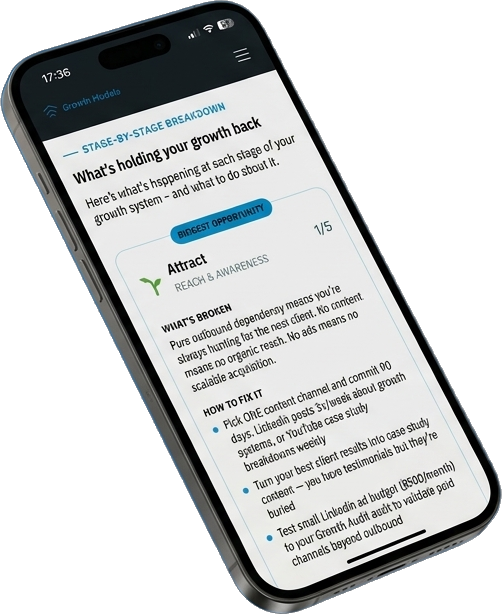
Want to see where your ascension system is broken? Take the free growth diagnostic. It maps your full customer journey across all five ACCER stages and shows you exactly where the biggest revenue gaps are hiding.