You install it once. You brief it about your offer. It does the team's work so you don't have to hire an agency or learn ad-buying yourself.
Right. Building's the easy part now. AI took care of that. The hard part, the part nobody's selling you a one-click solution for, is getting your built thing in front of people who'd actually buy it.
This is that one-click solution. (Roughly. There are about three clicks. We'll forgive ourselves.)
You install the agent in Claude Code. You brief it about your offer in plain English. Then it goes off and does...
You review what it recommends. You scale, kill, or test. The agent does the team's work. You make the strategic calls.
Built on Meta's official Ads CLI plus a 1,000-line custom MCP for the operations Meta hasn't exposed yet. Software you own. Runs locally. No subscription. No data leaving your machine.
The agent has the patterns from millions in ad spend baked in. Andromeda compliance, audience targeting, creative testing, the things ad agencies charge $5K/mo to do badly. You don't have to read another guru thread. The agent already read all of them.
You install once. The agent runs in your account, in your voice, with your brand context. No retainers. No juniors learning on your dime. No phone calls about strategy. (You can have phone calls if you miss them.)
The agent builds the distribution layer your launch is missing. Cold paid Meta, audience-tested, creative-rotated, performance-pruned. You wake up Wednesday morning and the campaign's already optimised itself overnight.
Recent results from operators running these ad systems on $1 products. Not hypothetical. Not curated highlight reels. Actual numbers.
The agent runs the same patterns these campaigns ran. Same architecture, same creative discipline, same performance pruning. Software shipping the playbook that produced the user results above.
How much have you spent learning to run ads so far?
A few courses? Maybe $500.
A pile of paid newsletters? Another $200.
The 47 hours of YouTube guru content you watched at 1.5x speed? Free, but those were 47 hours.
Maybe you ran some ads yourself. Lost a couple thousand figuring out targeting, creative, what to optimise for, why your CPM kept climbing while your CTR didn't move.
Maybe you hired an agency. $4,500 a month. The day-to-day was a junior account manager who'd been there four months Slacking you to ask what your offer was.
Add it up.
That's the entry fee for trying to solve the distribution problem the conventional way.
The agent is $27. Once.
This isn't one-click magic. It's just maths.
For most of the last decade, the hard part of running an online business was building the thing. Code. Design. Tech stack. Hosting. Payment processing. The reason there were so few bootstrapped businesses was that even getting from idea to "thing on the internet" was a six-month project.
That's gone. AI ate it.
You can ship a product over a weekend now. Cursor, Claude Code, Stripe. Twelve hours of effort. The thing exists.
Right.
So now what?
The bottleneck didn't disappear. It moved. The hard part isn't building anymore, it's getting anyone to look at the thing you built. Distribution. Audience. Acquisition. The unsexy work the AI conversation barely mentions because it doesn't fit the "you can build anything now" narrative.
The operators who shipped in the last 18 months and have buyers all solved distribution. The ones who shipped and have silence didn't.
This product is the distribution solver for builders. Not a course teaching you how. Not an agency you have to manage. Software that does it.
The agent runs that flow whenever you brief a new offer. Five stages, integrated, working off your specific context.
The setup is conversational. Open the agent in Claude Code. It walks you through Meta Business Manager, Page, Pixel, System User token, CLI install, MCP install, connection verification.
Setup time · ~1 hourTell the agent about your offer in plain English. It pulls research from the Meta Ad Library, builds your ICP, drafts your campaign architecture, generates copy, pre-loads everything paused.
Brief time · ~15 minLaunch when you're ready. The agent monitors performance, applies traffic-light pruning, and tells you each week what to scale, kill, and test next.
Weekly review · ~30 minEight integrated skills, plus a setup conductor, plus pre-loaded creative templates. Software you install once.
Conversational installer. Walks you through Meta accounts, token generation, install, verification. About an hour from zero to running.
Mines angles from competitor ads, reviews, community discussions, sales objections, audience language. Outputs a swipe file scored against your ICP.
Researches the Meta Ad Library specifically. Extracts winning angles, copy formulas, creative styles from ads with proven longevity in your niche.
Designs account structure. Testing campaign (ABO), scaling (CBO), retargeting, budget allocation. Andromeda-compliant JSON ready to deploy.
Generates ad copy and creative briefs using a 3x3x3 framework. Each batch produces variations ready for testing in a single ad set.
Production-ready video scripts you record from directly. Exact dialogue, timing, text overlay instructions, hook variants, filming notes.
Pulls performance data, applies traffic-light pruning, recommends scale/kill/rebuild. Names the winning elements you can compound.
Builds retargeting audiences, exclusion rules, budget splits, creative direction. JSON plan for warm-audience campaigns that pair with cold traffic.
Reviews every other skill's output at defined checkpoints before you see it. Catches weak output, flags voice issues, scores against proven patterns.
Pillow-based scripts that produce working ad creative without you opening a design tool. Fake tweet mockups, simple message cards, founder UGC formats. 1080×1080 PNG output, run from the terminal.
For context.
| One Meta ads consultant call | $300 to $500 |
| One month of agency retainer | $3,000 to $10,000 |
| One AI ads SaaS subscription (annual) | $1,200 to $5,000 |
| One bad campaign without a system | $5,000+ in burned spend |
| Six months of learning ad-buying yourself | priceless (but six months) |
| The Agent (yours forever, no recurring) | $27 |
You need to be able to install Claude Code or Codex. If you can install an app, you can install this. The setup conductor handles the rest.
No catch. $27 covers the cost of acquiring you as a customer plus a few dollars of profit. We make our money on the back-end community where you go deeper. You get a working system either way.
The agent works for any business that runs paid Meta ads. Service, ecom, info products, SaaS, local. The patterns scale across niches because the underlying ad mechanics don't change between markets.
You'll need a Meta Business Manager, a Page, a Pixel, and an ad account with payment method. The setup conductor walks you through anything missing, but if you have nothing yet, get those basics first.
No. Every framework and template came from real campaigns. The AI executes proven patterns, it doesn't invent them. There's a difference between using AI to do better work faster and using AI to pretend you did work.
You launched on a Tuesday.
Three months of building. Cursor open eighteen hours a day for the last two weeks. Three GPTs holding hands. A Stripe account that took longer to set up than the actual product. A landing page you rewrote four times.
You ship.
You post on X. "Just launched, here's the link." Your spouse-or-partner-or-roommate-or-the-dog reposts.
You watch the analytics tab for forty minutes.
There are seventeen visitors. Four are you, on different devices. Two are your mum. One is the developer you hired briefly six weeks ago who's clearly checking what you ended up building. The others have a session length of nine seconds.
By Friday, three people have signed up.
One of them was you.
Right.
This isn't a launch problem. It's a distribution problem. The thing you built is fine. The page you wrote is fine. The pricing is fine. Nobody's seeing it.
You weren't told this. You were told that AI fixed everything. Building was the bottleneck, building's free now, ergo, the world is your oyster.
The world is, technically, your oyster. You've got the oyster. It's right there.
What you don't have is the oyster's audience.
The conventional wisdom for the last five years was build something good and the market will find it. Better mousetrap, beaten path, etc.
This was always partially nonsense. The reason it became completely nonsense in 2024 is that everyone now has the AI tools to build something good. Building stopped being a moat the moment it became cheap.
Right.
So now there are 47,000 people shipping things that all look broadly fine. Real software. Real value. Reasonable design. Reasonable copy. The differentiator stopped being did you build it well and started being can you get anyone to know it exists.
Distribution is the new moat. Everyone says this. Hardly anyone tells you what to actually do about it.
Here are the options, and they all stink.
You can do organic content for two years and pray something hits the algorithm. Maybe you're charismatic. Maybe you've got a voice. Maybe you don't, and you'll spend two years recording videos that thirty-eight people see.
You can run paid Meta ads. This is the option that actually works at scale, in any niche, predictably. If you know what you're doing. Most builders don't. Most builders who try lose two thousand dollars learning that "boost post" isn't a strategy.
You can hire an agency. They're either expensive ($5 to $10K/mo retainer plus ad spend on top) or cheap-but-bad. The cheap-but-bad ones put a junior on your account who's learning Andromeda for the first time on your dime.
You can read forty hours of guru content on YouTube and try to do it yourself. Fine. We've all done that. You'll probably end up running ads, losing a few thousand, and concluding that "Facebook ads don't work anymore", a phrase that's been said for sixteen straight years and hasn't been true any of them.
The honest answer is that paid Meta ads are still the most predictable distribution channel for cold-traffic acquisition. It's just that running them well requires...
In other words, a team's worth of work.
You don't have a team. You have you and the cat.
That's the gap this product fills. Not "learn how to run ads". Not "we'll run them for you for $5K/mo". A piece of software that does the team's work and runs it in your account, for $27, once.
None of these are wrong because of the people running them. They're wrong because you're a builder, not an ad-buyer, and these were all built for ad-buyers.
You don't need someone to teach you how to run ads. You need a system that does the operator-level execution while you make the strategic calls.
Wednesday. Eight forty-five. Coffee.
You open Claude Code. Ask the agent for the week's read. It pulls the numbers and prints the report in your terminal.
You read it. You make three calls in 90 seconds. Scale 3. Pause 7. Yes, generate the variations.
The agent runs.
You go back to building the next thing.
That's what the rest of your week looks like. Not staring at Ads Manager. Not learning what "Advantage+ campaign budget" does. Not arguing with juniors at agencies.
The agent does the team's work. You make the calls.
This is what we've been doing for our own businesses for years. Pre-AI it took a team. Now it ships as software because Meta released the CLI specifically for AI agents to drive their Marketing API.
We're the first I've seen building this to fully manage Meta ads from natural language inside an AI agent. That's why this exists.
| Day 1 | Agent installed, connected to your Meta account, validated. Your offer briefed in. Context file generated. |
| Day 2 to 3 | Swipe file of 10 to 20 winning angles for your niche. Campaign architecture you've reviewed. First batch of ad copy and creative briefs. |
| Day 4 to 7 | Ads launched. PAUSED-by-default workflow respected. First performance read after 72 hours of data. |
| Week 2 onwards | Weekly performance review, scale-or-kill decisions, next batch of creative. 90-second Wednesday morning review instead of evening-long Ads Manager sessions. |
That's not theory. That's a working system you deploy this week.
Real user results from our ad systems with LTOs. The agent ships the same playbook.

Roughly 13 years in growth. I've run paid campaigns myself, managed teams who do, and built campaigns across most of the platforms that matter. SaaS, ecom, info, agencies, Series A funded, bootstrapped. Different stacks, same underlying mechanics.
The agent is the thing I wished existed every time a new client account landed and the work was the same shape it had been the last 30 times. Research, architecture, creative, deploy, prune. Everyone needs it. Most people pay a team to do it. The patterns don't change much.
So I built it as software. The checks the agent runs at deploy time, the defaults it ships with, the way it pairs cold and retargeting, the Andromeda settings it gets right by default. All of it came out of the work I've been doing with clients and on my own brands for the last decade-plus.
I'm offering it at $27 because shipping it as software became possible the moment Meta released the official Ads CLI, and because the front-end of a funnel is supposed to be cheap. The community is where the rest of the work happens.
I use it on my own work. When platform changes happen or better patterns emerge, I update the agent. You pull the latest. Updates are free for the life of the product.
You can have it for the price of two cups of coffee in central London. Of course.
If the agent doesn't install, doesn't connect, or doesn't work the way the demo shows it works, refund within 7 days. No questions, no retention specialist.
Beyond that, if you've tried it for a month and it hasn't paid for itself in saved time or improved ad performance, the agent isn't right for you and we'll refund.
Functionally, yes. Most agencies sell you a senior creative on the pitch and put a junior administrator on the day-to-day. The work that actually moves the needle is implementation and reporting, the agent does both. What this gives you is the strategic driver's seat. You make the calls about angles, audiences, offers. The agent enacts them in your account, runs the campaigns, and produces the same kind of weekly read an agency would. Without the retainer, the slide decks, or the Slack messages asking what your offer is.
The agent runs as skills inside an AI coding assistant. Claude Code (Anthropic) and Codex (OpenAI) both support the architecture. Either works. We test against Claude Code as primary.
Standard ChatGPT doesn't have file system access or terminal access, both required. ChatGPT-with-Codex does. So does Claude Code.
Most are SaaS dashboards with a ChatGPT wrapper. They don't run in your terminal, don't talk directly to Meta's CLI, and have a monthly fee. This is software you own, running locally, with no subscription. No data leaving your machine.
Yes. Multi-brand setup is built in. Switch between brands with one command. Each brand keeps its own credentials, context, and learnings isolated.
The agent is built around them. Andromeda compliance is set correctly by default. Degrees_of_freedom_spec, advantage_audience controls, the things Meta locks after ad set creation that 90% of agencies still get wrong.
We update the agent. The CLI is officially supported by Meta with versioning policy. Breaking changes happen at major version bumps and we handle them.
Yes. After checkout you'll see optional offers. The agent works independently of all of them, so you don't need to take them. They're there if you want results faster or more help growing your business. Not required.
Because acquiring buyers at break-even on a low-ticket front-end and serving a smaller percentage on the back-end community is a better business than charging $497 once and not building a relationship. We do better when you do better.
Two builders read this page today.
One closes the tab. They go back to refreshing analytics. A week later there are still seventeen visitors and three of them are still them.
The other enters their email. A week later the agent has researched their niche, drafted a campaign, generated creative, deployed it paused, and is waiting for approval to push live. By the week after that the launch they shipped finally has buyers.
Both built the same product. Both shipped on the same day.
The only thing that separated them was one decision.
This website is not part of the Facebook or Meta websites or Meta Platforms, Inc. Additionally, this site is NOT endorsed by Facebook or Meta in any way. FACEBOOK and META are trademarks of Meta Platforms, Inc.
The results shared on this page are not typical and your results will vary. These testimonials are not intended to represent or guarantee that everyone will achieve the same results. Individual results depend on your effort, commitment, and follow-through. Any business endeavour carries inherent risks and there are no guarantees of success.
We offer a 7-day money-back guarantee from the date of purchase. If you're not satisfied with the AI Meta Ads Agent for any reason within 7 days, contact us for a full refund.
The testimonials and examples shown are real results from actual clients. However, these results are not typical and your results may vary. Past performance does not guarantee future results.
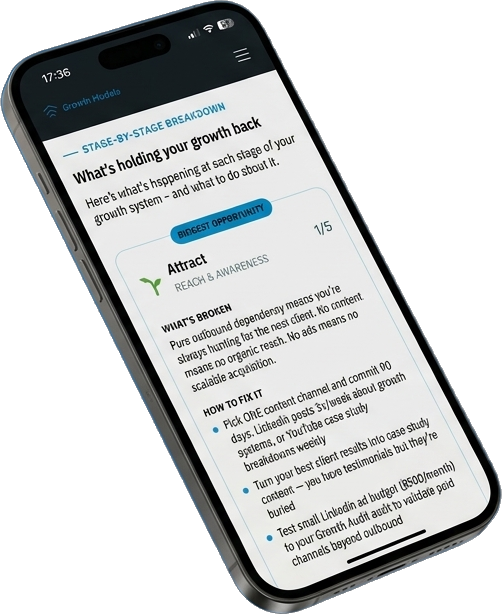
Answer a few questions about how you get and keep customers. A simple five-step diagnostic shows you the handful of actions that'll grow your business more profitably, in a detailed report built on your answers.
Take the free diagnostic → No thanks, I'll keep guessing what to fix